
Why Third-Party-Tested Peptides Matter for Research
DISCLAIMER: This article is for informational and educational purposes only. All products referenced are sold strictly for laboratory and research use by qualified professionals. Not for human consumption, veterinary use, or diagnostic use.
Third-party-tested peptides are growing in popularity and demand across research in different industries, including biotechnology and pharmacology.
Because of the highly sensitive nature of these studies, analytical verification and quality assurance are important, especially when conducted by a third-party, non-related entity to the manufacturer and the supplier, to ensure unbiased and accurate reporting.
This guide will cover why independent testing matters for research peptides, the standard assays to ensure quality and identity, and what it means for both the peptide supplier and the researcher.
Why Third-Party Tested Peptides Matter in Scientific Research
Third-party testing refers to analyses conducted by independent peptide testing labs to verify peptide identity, purity, concentration, and contamination levels.
These tests are conducted outside the manufacturer’s and supplier’s internal operations to ensure unbiased, high-quality reporting. It assures laboratories and researchers that they are working with the exact molecule required for the study.
Any inconsistencies in purity, residual solvents, heavy metals, or synthesis byproducts, even if minimal, can affect laboratory data and increase risks associated with poorly characterized compounds.
Using a peptide without third-party testing poses severe risks to participant safety, data integrity, and regulatory compliance. Unverified peptides may contain dangerous contaminants and can trigger unpredictable, life-threatening adverse reactions or completely invalidate the scientific validity of the study
Common Third-Party Testing Models Used for Research Peptides in the USA
Research peptides are not intended for human or clinical consumption. Because of this, these Standard Quality Assurance (QA) assays focus solely on chemical validation to assess identity, purity, and structural integrity, ensuring that what’s in the vial is exactly what it claims to be.
High-Performance Liquid Chromatography (HPLC)
HPLC is a common method for determining peptide purity as a percentage and identifying potential impurities.
It works by dissolving a sample in a liquid mixture, passing it through a pressurized column, and separating the peptides based on their hydrophobicity, molecular size, or electrical charge, and how each interacts with the column’s chemistry.
The researchers would conduct qualitative and quantitative analyses of the components, including the amounts of each in the sample.
The findings are reported via a chromatogram, as seen in a peptide’s Certificate of Analysis.
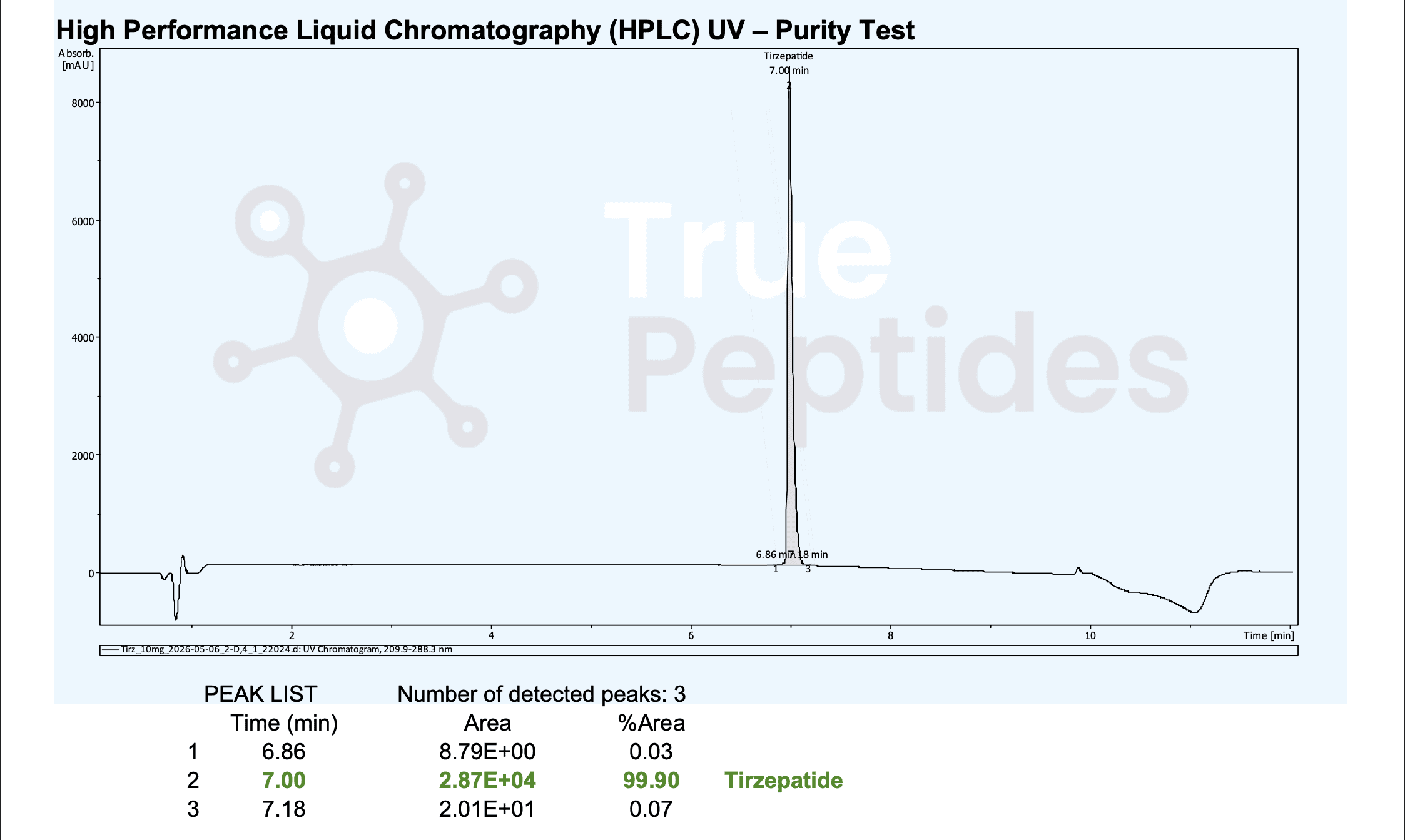
For True Peptides, the purity of our third-party-tested peptides was analyzed via HPLC-UV.
HPLC-UV uses ultraviolet detection to quantify and, therefore, verify the purity of the peptide via UV absorbance.
Mass Spectrometry (MS)
Mass spectrometry is a test that measures the mass-to-charge ratio of a peptide in a sample, identifying and confirming its identity through molecular weight and structural verification.
To do this, a sample is vaporized and either stripped of electrons (hard ionization) or protonated (attached to protons) to convert neutral molecules into positively charged gas-phase ions.
These new ions are then repelled by electric plates to give them the same kinetic energy as they enter a magnetic or electric field analyzer, which separates lighter ions from heavier ions and can thus distinguish the mass-to-charge ratio.
This allows the analytical chemist to compare the measured mass to the expected molecular mass of the peptide, as seen below.
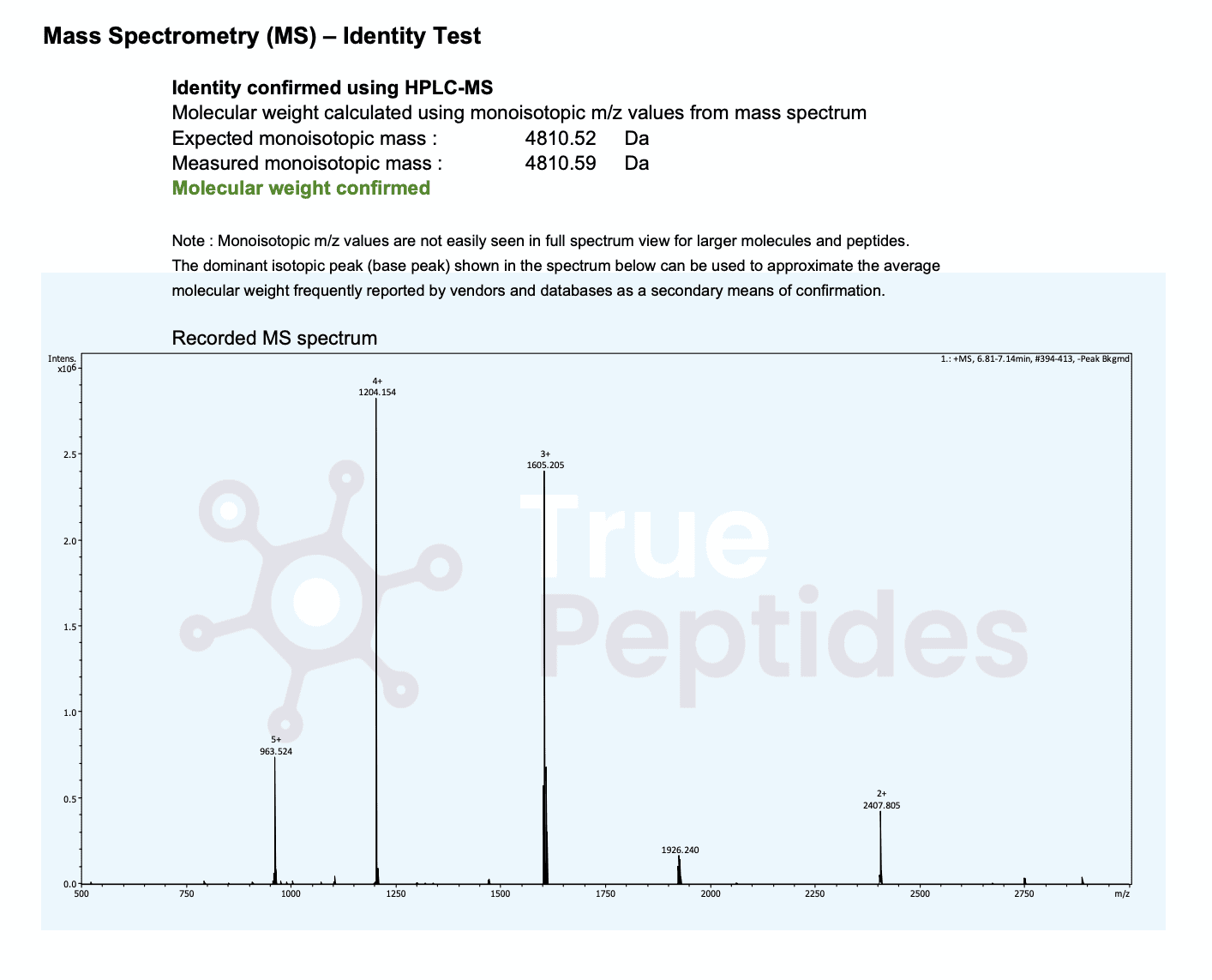
While HPLC and MS are the gold standard for determining a peptide’s identity and purity, other third-party tests can be conducted to confirm a peptide’s safety and degradation metrics, including amino acid analysis, endotoxin screening, and degradation testing.
Amino Acid Analysis (AAA)
AAA is a technique that quantifies specific amino acids that comprise the research peptide. It provides a detailed compositional audit and the exact ratios to detect missing or excess amino acids. However, with the advent of mass spectrometric sequencing, it is now used less frequently.
Endotoxin Screening
This screening is done to detect any microbial presence or contamination risks in peptide compounds. These bacterial toxin fragments may be remnants of the synthesis that standard purity tests can’t detect.
Endotoxin screening is highly recommended for research peptides used in cell cultures or living models, as unscreened peptides may compromise experiments or endanger animal models in the laboratory.
Residual Solvent Testing
While endotoxin screening looks for residual bacterial fragments, residual solvent testing tests for volatile organic compounds, such as acetonitrile, trifluoroacetic acid (TFA), or dimethylformamide, that may remain from the synthesis and purification process.
These chemicals can harm cells and affect the conduct and outcome of the study.
Stability and Degradation Testing
Peptide testing labs subject the sample peptide to various stressors or environments that may affect its stability and cause degradation.
The information obtained here is useful for directly determining the official shelf life and for establishing best practices for handling and storing research peptides for long-term use in a laboratory.
Why Trust True Peptides’ Third-Party-Tested Peptides
True Peptides is committed to meeting the high standards expected in peptide sciences and laboratory research. Our high-purity research peptides at 99%+ are supported by analytical verification from our manufacturers and third-party peptide testing labs.
Every lot of our compounds is tested; not spot checked, not randomly sampled. They are assessed and verified by MZ Biolabs, located in Arizona, USA.
Customers can expect:
- Properly labeled vials with a unique lot number for easy tracking. This lot number is linked to the purity percentage, documented quantity, and a Certificate of Analysis, which clients can check on the product page before ordering.
- Full matching documentation. Each lot gets its own paperwork and testing. No recycled COAs.
- Full traceability. Every vial, COA, and test result is linked together. Customers can trace any product back to its lot, its test data, and its source documentation.
True Peptides maintains our transparency and integrity by providing high-quality research peptides that researchers can trust. We ship orders placed before 2 PM PST, and our support team is just an email away to assist with any queries.
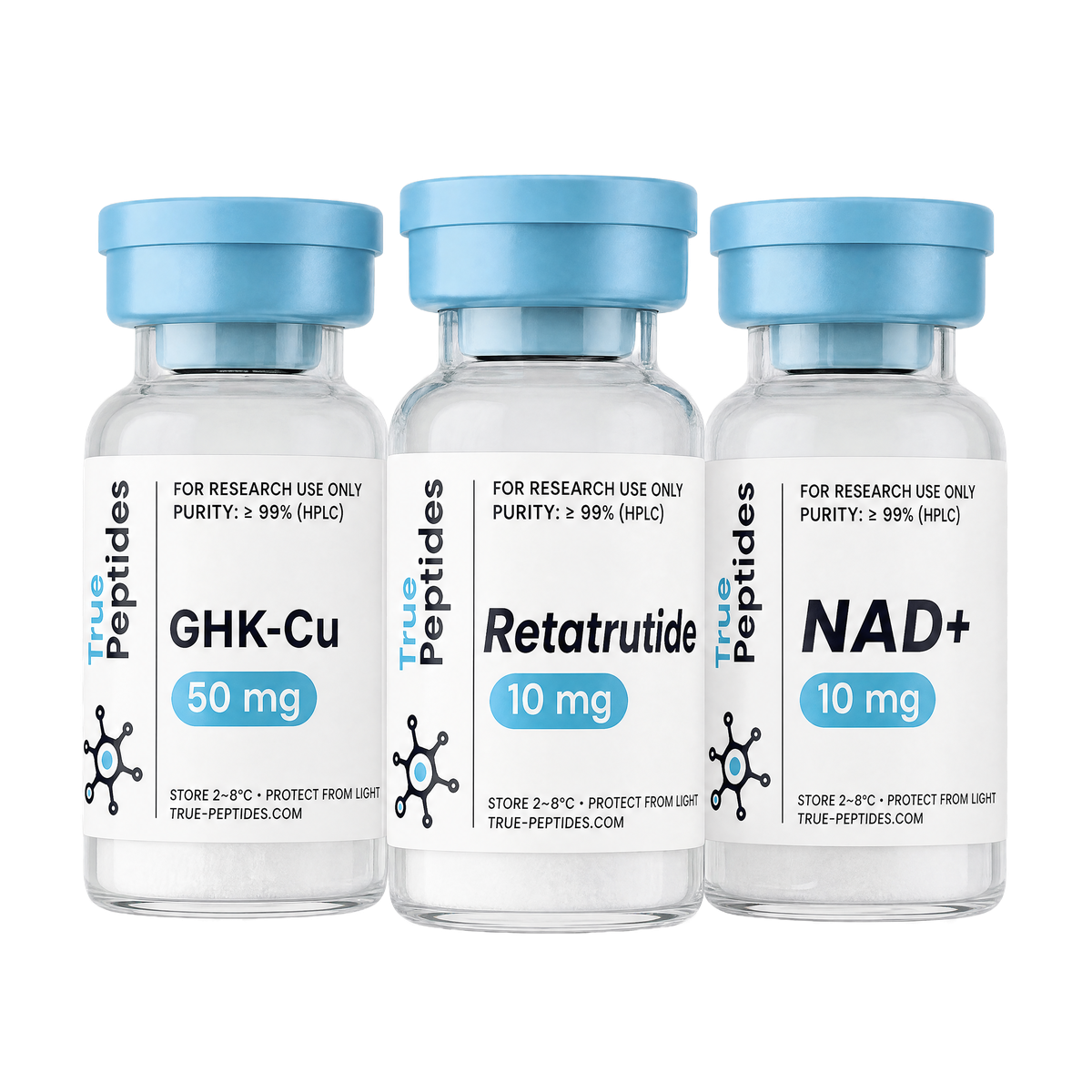
See more of our high-purity research peptides here:
Frequently Asked Questions (FAQs)
Are research peptides regulated in the United States?
Yes, research peptides are heavily regulated in the United States based on their intended use, labeling, and distribution.
Peptides that are explicitly labeled as “For Research-Use Only” are intended to be used only as such, and must only be used and purchased by professionals in a laboratory setting.
Manufacturers and suppliers must comply with the FDA, DEA, and other regulatory bodies when selling research peptides online.
What information should appear on a peptide Certificate of Analysis?
Laboratories and researchers who purchase US-made research peptides can only rely on the peptide Certificate of Analysis to confirm their identity and quality.
The COA must include important information, including the peptide name, lot number, purity percentage, manufacturer, and/or third-party peptide testing labs, and the results of testing methods for purity and identity.
All information must match the information on the peptide packaging and the website. See our lists of Certificate of Analyses here.
Why do laboratories prefer independently tested peptides?
Third-party vetification from peptide testing labs can help confirm the purity, identity, and batch consistency of every peptide lot, without relying solely on the manufacturer’s and supplier’s internal testing and marketing.
This transparency helps build confidence that the study’s outcomes are reliable and reproducible, given the consistent quality of the research peptides used in the experiment.
Explore our other articles linked below!
- Research Peptides for Laboratory Use: Best Practices and Standards
- How to Optimize Peptide Solubility for Experimental Use
- How to Reconstitute Peptides for Laboratory Use
DISCLAIMER:Products sold by True Peptides are intended for laboratory and research use only. They are not drugs, food, or dietary supplements, and are not intended to diagnose, treat, cure, or prevent any disease. Not for human or animal consumption.
REFERENCES+
- Wysocki, V., Resing, K., Zhang, Q., Cheng, G. (2005) Mass spectrometry of peptides and proteins, Methods, Volume 35, Issue 3, Pages 211-222, ISSN 1046-2023. https://doi.org/10.1016/j.ymeth.2004.08.013.
- https://www.shimadzu.com/an/service-support/technical-support/analysis-basics/basic/what_is_hplc.html
- https://www.chromatographyonline.com/view/how-it-works-uv-detection-hplc-0
- https://www.sciencedirect.com/topics/medicine-and-dentistry/amino-acid-analysis
- https://www.finnrick.com/blog/why-endotoxin-testing-matters-for-peptides
- https://www.uspnf.com/sites/default/files/usp_pdf/EN/USPNF/usp-nf-notices/86-bacterial-endotoxins-tests-using-recombinant-reagents.pdf