
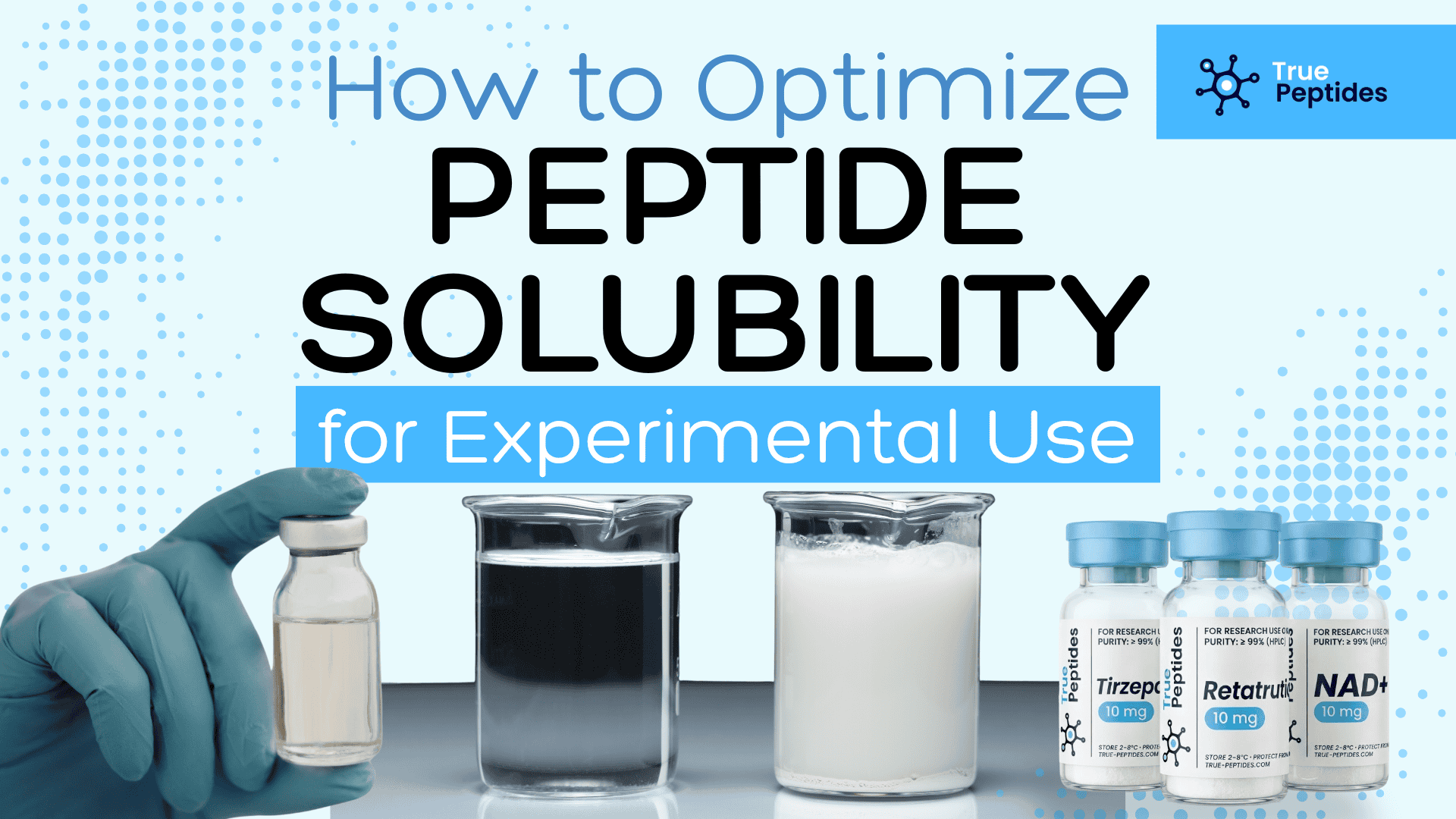
KEY TAKEAWAYS: Choose a proper solvent based on the research peptide’s amino acids, peptide length and structure, net charge, and hydrophobicity. In principle, net positive or basic peptides are best dissolved in acidic solutions, while net negative or acidic peptides require basic solutions. Lastly, use proper techniques or specialized tools, like a sonicator, to enhance disolution.
DISCLAIMER: This article is for informational and educational purposes only. All products referenced are sold strictly for laboratory and research use by qualified professionals. Not for human consumption, veterinary use, or diagnostic use.
Synthetic peptides for laboratory use vary widely in their ability to dissolve in solvents due to differences in their amino acid composition, sequence, and physicochemical properties.
Short peptides can dissolve in pure water; charged sequences are better with aqueous buffers, and hydrophobic peptides, which repel water, require organic solvents and dilution.
Understanding and optimizing peptide solubility is crucial to the success of the experiment, the accuracy of peptide concentration measurements, and the overall development of research applications.
This guide covers strategies to optimize peptide solubility, including matching the right solvent with the right peptide and techniques to improve solubility.
What is Peptide Solubility?
Peptide solubility refers to the ability of the peptide to dissolve in a solvent to form a clear, homogenous solution.
Calculating the solubility limit of a peptide is essential for determining the maximum concentration at which it can be dissolved reliably, which is critical for experimental reproducibility and formulation design.
Insufficient solubility can limit the achievable concentration of the peptide solution, potentially altering biological or analytical outcomes.
Low solubility means more time spent in an aggregated cluster, while high solubility means otherwise. This aggregation (clumping of molecules) and precipitation (dissolved substances becoming insoluble and separating from the solvent) can introduce variability, reducing the solution’s reliability and reproducibility for experimental use.
RELATED: How to Reconstitute Peptides for Laboratory Use
What Determines Peptide Solubility
1. Composition of Amino Acids
The amino acid composition of a peptide determines its hydrophobicity (ability to repel water) or hydrophilicity (ability to attract water).
Peptides containing >50% of non-polar, hydrophobic amino acids, such as Leucine (L), Valine (V), Isoleucine (I), Phenylalanine (F), Tryptophan (W), Methionine (M), and Proline (P), have reduced aqueous solubility.
On the other hand, peptides with a high content of charged or ionized residues, typically >25% of Lysine (K), Arginine (R), Aspartic Acid (D), and Glutamic Acid (E), exhibit improved solubility due to their ability to interact with water molecules.
2. Peptide Length and Structure
Short peptides or oligopeptides are peptides with a chain of <10 to 20 amino acids. They tend to dissolve more readily in solvents and are less prone to self-aggregation because they have fewer hydrophobic areas to clump together.
Longer peptides or polypeptides, on the other hand, typically have more than 10 to 50 amino acids. A structure of peptide chains with >50 amino acids is what makes a protein. Polypeptides can be less soluble, especially when misfolded or containing high concentrations of hydrophobic amino acids, which can lead to aggregation.
Self-assembling peptides, or those that can form ordered structures on their own (like β-sheets), can aggregate and form gels, which can make it notoriously difficult to dissolve in solvents.
3. Net Charge and Isoelectric Point (pI)
The net charge can determine a peptide’s solubility. Net charge refers to the sum of all positive and negative ionizable charges in a peptide and can determine how it interacts with water.
A net charge of zero, called the isoelectric point, is where the solubility is lowest, while a high net charge, either positive or negative, results in better solubility.
How to Select the Best Solvent for Optimized Peptide Solubility
Common methods for dissolving peptides include using aqueous solvents, organic solvents, or co-solvents (mixtures of the two).
Aqueous Solvents
Aqueous solvents are liquid that primarily consists of >50% water used to dissolve solutes. They are considered universal solvents, being able to dissolve ionic compounds, and are highly polar and non-flammable. These solvents are also biodegradable and can conduct electricity when electrolytes are present.
Solutions made with aqueous solvents are called aqueous solutions, water-based solutions, or hydrophilic solutions.
Common aqueous solvents for peptides include phosphate-buffered saline (PBS) and highly purified water, such as deionized or ultrapure water.
Organic Solvents
Organic solvents are carbon-based liquid compounds used to dissolve hydrophobic peptides. These solvents contain carbon-hydrogen bonds and can disrupt nonpolar and intermolecular interactions that lead to peptide aggregation and precipitation in water.
They are also highly polar and aprotic (cannot form hydrogen bonds with themselves), which makes them effective solvents for non-polar amino acids and for breaking down the secondary structures that hydrophobic peptides form.
Commonly used organic solvents include Dimethylsulfoxide (DMSO), methanol, and Dimethylformamide (DMF).
Co-solvent Systems
Co-solvent systems refer to the mixture of solvents to improve the solubility of peptides.
Typically, co-solvents are a mixture of water and one or more organic solvents. This mixture helps decrease the water’s polarity, disrupts the hydrogen-bonded water structure, and reduces the tension between the solvent and the hydrophobic peptide.
However, peptides dissolved in organic solvents may precipitate when introduced into aqueous environments.
DMSO is often the first choice, mixed with water and used at 10-50% concentrations. While pure DMSO is highly effective for hydrophobic peptides, some researchers would add a DMSO-water mixture (or aqueous buffers) to reduce toxicity for biological experiments or activities.
RELATED: Research Peptides for Laboratory Use: Best Practices and Standards
3 Tips to Optimize Peptide Solubility for Experimental Use
1. Assess the Net Charge and Hydrophobicity
Check the research peptide’s documentation to identify the specific amino acids in the sequence that have ionizable side chains. Calculate the total number of acidic residues (Asp, Glu, C-terminal COOH) and basic residues (Lys, Arg, His) to determine the overall peptide nature.
Evaluate the hydrophobicity by checking for the presence of W, L, I, F, M, V, Y, P, and A. Peptides with these residues generally have low solubility in aqueous solutions.
Using peptide solubility calculators online will make this process easier.
Testing solubility with a small aliquot is also a good practice to determine what works best before reconstituting the entire sample.
2. Solubility Strategies by Type
In principle, net positive or basic peptides are best dissolved in acidic solutions, while net negative or acidic peptides require basic solutions.
Matching the solvent ot peptide chemistry helps maximize the peptide’s charge and improve its solubility in aqueous solutions.
For basic peptides, aqueous solvent should work perfectly. If not, add a small amount of 10% to 30% acetic acid or 0.1% trifluoroacetic acid (TFA). However, if the peptide will be used for cell culture or assays, TFA can be toxic to cells. In this case, DMSO or ACN may be the better option.
For acidic peptides, sterile water or 1x PBS (pH 7.4) can also be used. If it doesn’t, add a small amount of ammonium hydroxide to raise the pH. Small amounts of organic solvents can prevent aggregation in aqueous systems.
Neutral and Hydrophobic peptides can be reconstituted in 100% organic solvents, such as DMSO, DMF, or ACN. If the peptides are particularly difficult to dissolve, 6M guanidine-HCl or 8M urea can help break hydrophobic interactions; however, they can interfere with experiments.
3. Techniques to Enhance Dissolution
For the most part, the gentle swirling of peptide and solvent is sufficient to dissolve all particles and create a clear solution. If not, a brief sonication in a water bath can enhance the peptide’s solubility, as high-frequency sound waves help break down aggregates.
Allowing both the solvent and the peptide to reach room temperature before reconstitution will also aid dissolution.
Another technique that is best used is the Dropwise dilution, where the peptide is dissolved in an organic solvent first, then added dropwise to the aqueous buffer to avoid abrupt changes in solvent composition that may cause aggregation or precipitation.
The Stepwise Dissolution technique may also work. Here, the solid sample is dissolved in stages: first with a small amount of organic solvent, then slowly mixed with the aqueous buffer or added in drops.
Some suggest slightly warming the solvent to help dissolve the powdered peptide; however, this should be done with great caution, as high temperatures can increase the likelihood of degradation.
Testing the peptide’s solubility in small samples or aliquots will also minimize material loss and help select the ideal solvent without using the entire batch.
Why True Peptides Is the Best Place to Buy Peptides
True Peptides is committed to meeting the high standards expected in peptide sciences and laboratory research. Our high-purity research peptides at 99%+ are supported by analytical verification from our manufacturers and third-party testers.
Every lot of our compounds is tested; not spot checked, not randomly sampled.
Customers can expect:
- Properly labeled vials with a unique lot number for easy tracking. This lot number is linked to the purity percentage, documented quantity, and a Certificate of Analysis, which clients can check on the product page before ordering.
- Full matching documentation. Each lot gets its own paperwork and testing. No recycled COAs.
- Full traceability. Every vial, COA, and test result is linked together. Customers can trace any product back to its lot, its test data, and its source documentation.
True Peptides maintains our transparency and integrity by providing high-quality research peptides that researchers can trust. We ship orders placed before 2 PM PST, and our support team is just an email away to assist with any queries.
Learn more about our popular research peptides here:
Check out more related articles below!
- The Ultimate Guide to Retatrutide for Research Use
- The Ultimate Guide to Research-Grade trizep
- How to Store Peptides for Long-Term Research Use
FAQs About Peptide Solubility
What is the most important factor affecting peptide solubility?
The peptides’ length and structure, amino acid composition, and overall sequence are big factors in their solubility.
Peptides with hydrophilic or charged residues are more soluble, while those containing hydrophobic residues will resist solubility.
Why do some peptides not dissolve in water?
These peptides contain hydrophobic amino acids, which repel water. Dissolving them in water will only lead to clustering or aggregation, which can reduce their interaction with the solvent.
In some cases, strong intermolecular interactions, such as hydrogen bonding, can stabilize aggregates.
How does pH influence peptide solubility?
pH affects the ionization state of amino acid side chains, which changes the peptide’s net charge.
At pH values where the peptide carries more charge, solubility typically increases due to electrostatic repulsion between molecules.
Near the peptide’s isoelectric point (pI), solubility is lowest because the net charge is minimal, promoting aggregation.
Are organic solvents necessary for all peptides?
No, most peptides dissolve well in aqueous buffers, especially if they are polar or charged.
However, hydrophobic peptides may require small amounts of organic solvents (e.g., DMSO or acetonitrile) to initiate dissolution before dilution in water. These solvents should be used carefully to avoid affecting downstream experiments.
Can improving solubility affect peptide stability?
Yes, improving solubility can enhance stability by reducing aggregation and ensuring uniform distribution in solution.
However, some methods (like extreme pH or certain solvents) can accelerate chemical degradation. The goal is to balance solubility with conditions that preserve peptide integrity over time.
DISCLAIMER: Products sold by True Peptides are intended for laboratory and research use only. They are not drugs, food, or dietary supplements, and are not intended to diagnose, treat, cure, or prevent any disease. Not for human or animal consumption.
REFERENCES+
- Kovacs, J. M., Mant, C. T., & Hodges, R. S. (2006). Determination of intrinsic hydrophilicity/hydrophobicity of amino acid side chains in peptides in the absence of nearest-neighbor or conformational effects. Biopolymers, 84(3), 283–297. https://doi.org/10.1002/bip.20417
- Sarma, R., Wong, K. Y., Lynch, G. C., & Pettitt, B. M. (2018). Peptide Solubility Limits: Backbone and Side-Chain Interactions. The journal of physical chemistry. B, 122(13), 3528–3539. https://doi.org/10.1021/acs.jpcb.7b10734
- https://bio.libretexts.org/Workbench/Biochem_Remix_Acevedo/03%3A_Amino_Acids_Peptides_and_Proteins/3.01%3A_Amino_Acids_and_Peptides
- Apostolopoulos, V., Bojarska, J., Chai, T. T., Elnagdy, S., Kaczmarek, K., Matsoukas, J., New, R., Parang, K., Lopez, O. P., Parhiz, H., Perera, C. O., Pickholz, M., Remko, M., Saviano, M., Skwarczynski, M., Tang, Y., Wolf, W. M., Yoshiya, T., Zabrocki, J., Zielenkiewicz, P., … Toth, I. (2021). A Global Review on Short Peptides: Frontiers and Perspectives. Molecules (Basel, Switzerland), 26(2), 430. https://doi.org/10.3390/molecules26020430
- Bruno Rizzuti, Valerie Daggett, Using simulations to provide the framework for experimental protein folding studies, Archives of Biochemistry and Biophysics, Volume 531, Issues 1–2, 2013, Pages 128-135, ISSN 0003-9861, https://doi.org/10.1016/j.abb.2012.12.015.
- https://en.wikipedia.org/wiki/Beta_sheet
- William H. Deni, Tong Gao, Jinhua Wu, Protocol for reconstituting peptides/peptidomimetics from DMSO to aqueous buffers for circular dichroism analyses, STAR Protocols, Volume 5, Issue 1, 2024, 102850, ISSN 2666-1667, https://doi.org/10.1016/j.xpro.2024.102850.
- Hluska, Tomáš. (2017). Re: How to dissolve acidic peptide?. Retrieved from: https://www.researchgate.net/post/How-to-dissolve-acidic-peptide/59ae8ec83d7f4b329351d6ba/citation/download.