

KEY TAKEAWAYS: Prepare the research peptide, solvent, calibrated pipette, and waste disposal. Calculate peptide to solvent ratio for desired consistency, then sanitize the tools and workstation. When diluting the peptide, remember to swirl, not shake. Aliquot and label the compound, and store properly for long-term research use.
DISCLAIMER: This article is for informational and educational purposes only. All products referenced are sold strictly for laboratory and research use by qualified professionals. Not for human consumption, veterinary use, or diagnostic use.
Research peptides are often sold lyophilized (freeze-dried) or in powder form to ensure stability and extend shelf life.
Because lyophilization removes the water necessary for biological activity in peptides, biotech peptides reconstitution is important to reactivate them and make them functional for laboratory use.
In this guide, we’ll discuss the necessary steps and materials for reconstituting lyophilized peptides, along with best practices, quality considerations, and common errors to avoid.
What Are Lyophilized Peptides?
Lyophilization, or freeze-drying, is a process of dehydrating sensitive materials at low temperatures to preserve their structure, stability, formulation, and bioactivity, and then using a high vacuum to convert the material’s liquid water content into gas via sublimation, which effectively extends a peptide’s shelf life.
This practice has long been the standard for pharmaceuticals, biologics, and the food industry since the rise of biotechnology in the 1970s and 1980s.
For peptides, freeze-drying helps stabilize them for long-term storage and transportation by reducing their weight, enabling ambient-temperature storage during handling and shipping while preserving the product’s potency and integrity.
The degradation rate is also significantly lower for lyophilized peptides than for liquid forms.
Biotech Peptides Reconstitution: What Is It?
Biotech peptides reconstitution is the process of adding a solvent to a lyophilized peptide to create a solution ready for use in a laboratory setting.
Simply put, it’s rehydrating the freeze-dried powder by adding a liquid to activate it.
However, reconstituting peptides is a delicate process that requires safe materials and sterile, gentle techniques, as improper or inconsistent reconstitution can significantly impact experimental outcomes.
Peptide Solubility for Reconstitution
Different peptides have different solubilities based on their amino acid composition. If a peptide is primarily acidic, it will require a mildly basic or high-pH solvent to dissolve properly. On the other hand, if a peptide is basic, it will need an acidic solvent to dissolve.
This is important to achieve a clear, particle-free solution.
trizep, for example, is generally acidic in its lyophilized, stable form. It has low aqueous solubility but dissolves readily in organic solvents, such as Dimethyl sulfoxide (DMSO), or can be formulated in buffers, such as phosphate-buffered saline (PBS), for laboratory use.
Retatrutide, on the other hand, has high water solubility. For in-vitro work it is typically dissolved in sterile water or an assay-appropriate buffer such as PBS; choose the solvent that matches the downstream assay and record it with the sample.
RELATED: How to Optimize Peptide Solubility for Experimental Use
Materials and Equipment for Biotech Peptides Reconstitution
While lyophilized peptides are generally stable, they still require a sterile environment and a delicate process to maximize their potential and preserve their integrity for experimental use.
Solvents Commonly Used
The solvents best suited for peptide reconstitution depend on several factors, including hydrophobicity (how they repel water), charge (the balance of their positive and negative ions), and stability.
The most common options are:
- Sterile, nuclease-free water for general purposes
- Sterile water for sensitive peptides
- Special buffers, such as phosphate-buffered saline (PBS)
- Organic solvents, such as Dimethyl Sulfoxide (DMSO), Dilute Acetic Acid, or Dilute Ammonium Hydroxide, for hydrophobic/ challenging peptides
If unsure, the best way to know which to use is to test the solubility of a tiny sample, about 1 mg aliquot, of the peptide before dissolving the whole batch.
Laboratory Equipment
Reconstituting biotech peptides is a delicate process that requires sterile techniques and a controlled environment to avoid contamination.
Some of the basic, necessary tools are:
- The peptide vial where the powder is
- Solvent to dilute the powder in
- A calibrated pipette to transfer the solvent
- 70% isopropyl alcohol and lint-free wipes to sanitize the bench and tools
- Laminar flow hood (an enclosed and sanitized laboratory workstation) and ultrasonicator (for challenging peptides that do not dissolve easily)
- Miscellaneous tools, such as a timer, additional vials for smaller aliquots, and labeling tools
- Safety tools such as gloves, goggles, and a laboratory coat.
- Waste management, such as a sharps disposal container
Step-by-Step Process for Reconstituting Lyophilized Peptide
1. Calculate Desired Concentration
The desired concentration depends on the experiment being conducted with peptides, but generally, researchers use the following formula:
Concentration (mg/ml) = Total Peptide amount (mg)/ Volume of Solvent added (ml)
This formula can be adjusted depending on the specific concentration the researchers need for the study.
As peptides are highly potent and delicate, precision is important when calculating concentrations to ensure accuracy and reproducibility.
Online calculators for peptide reconstitution for laboratory use are also available and free to access.
2. Prepare the Workstation
Once done, sanitize everything in the workstation to prevent contamination. Clean the area with a detergent to remove debris, then disinfect with an appropriate disinfectant, such as 70% isopropyl alcohol or ethanol.
Wipe the outside of the vial and its closure with 70% isopropyl alcohol and let it dry. This keeps the workstation sterile and prevents contamination.
3. Dilute and Swirl
Using the pipette, dispense the measured volume of solvent slowly down the inside wall of the open vial so it runs onto the powder rather than hitting it directly. Direct, forceful contact between the solvent and the peptide can compromise its integrity and damage its structure.
Once done, do not shake the vial. Gently swirl it or roll it between your hands for a couple of minutes until the peptide powder dissolves.
Reconstituting a hydrophobic peptide may require an ultrasonicator or a bath sonicator, devices that use ultrasonic waves to dissolve solid peptides without breaking the particles.
4. Aliquot and Label
If working with a large batch, aliquoting or portioning the reconstituted peptides into small samples is important to prevent repeated freeze-thaw cycles.
Labeling each vial is important for documentation and traceability, too. Labels should include the peptide name/ sequence, date of reconstitution, concentration, batch/lot number, and storage requirements.
5. Store
A reconstituted peptide can degrade much more rapidly than a lyophilized one, especially when stored or handled improperly.
The ideal storage temperature is between -20° C and -80° C to maintain stability and extend its lifespan. For short-term use, reconstituted peptides can be stored at 2° C to 8° C for 28 to 30 days before they start to degrade.
Exposure to light, oxygen, heat fluctuation, and mechanical stressors can also affect the peptide’s potency and integrity, thereby affecting the study results.
RELATED: How to Store Peptides for Long-Term Research Use
Safety Considerations When Choosing the Solvent
Some residues found in peptides do not go well with certain solvents. Refer to the table below for easy reference.
| For peptides containing… | Avoid… |
| Cysteine or Methionine | DMSO, as it can cause oxidation. Use oxygen-free solvents instead. |
| Asparagine or Glutamine | Alkaline buffers with a pH>6, as they promote deamidation. |
| Aspartic Acid | Low pH or strong acids, as this can lead to dehydration or the formation of aspartimide. |
| Asp-Pro Residues | Strong acids or acidic conditions. This can lead to cleavage of the peptide bond between Aspartate and Proline. |
| Val, Leu, Ile, Met, Phe, and other hydrophobic residues | Pure water, as this can lead to aggregation and precipitation |
Mixing in the wrong solvent may also lead to assay incompatibilities. Avoid these combinations:
| Mixing… | Can result in… |
| TFA (Trifluoroacetic Acid) + HPLC Injection | Poor binding to the C18 column, especially at a high TFA concentration (>0.5 mg) before HPLC |
| Phosphate Buffers (PBS) + Hydrophobic peptides | Precipitation caused by phosphate salts in PBS when mixed with a peptide with low solubility |
| DMSO + High-Throughput Screenings | Toxicity in cells or undesirable effects on enzymatic activity, especially with high percentages of DMSO in assays |
| Acetone/Acetonitrile + Long-Term Storage | Evaporation, leading to concentration changes or precipitation |
RELATED: Research Peptides for Laboratory Use: Best Practices and Standards
Why True Peptides Is the Best Place to Buy Peptides
True Peptides is committed to meeting the high standards expected in peptide sciences and laboratory research. Our high-purity research peptides at 99%+ are supported by analytical verification from our manufacturers and third-party testers.
Every lot of our compounds is tested; not spot checked, not randomly sampled.
Customers can expect:
- Properly labeled vials with a unique lot number for easy tracking. This lot number is linked to the purity percentage, documented quantity, and a Certificate of Analysis, which clients can check on the product page before ordering.
- Full matching documentation. Each lot gets its own paperwork and testing. No recycled COAs.
- Full traceability. Every vial, COA, and test result is linked together. Customers can trace any product back to its lot, its test data, and its source documentation.
True Peptides maintains our transparency and integrity by providing high-quality research peptides that researchers can trust. We ship orders placed before 2 PM PST, and our support team is just an email away to assist with any queries.
See more of our high-purity research peptides here:
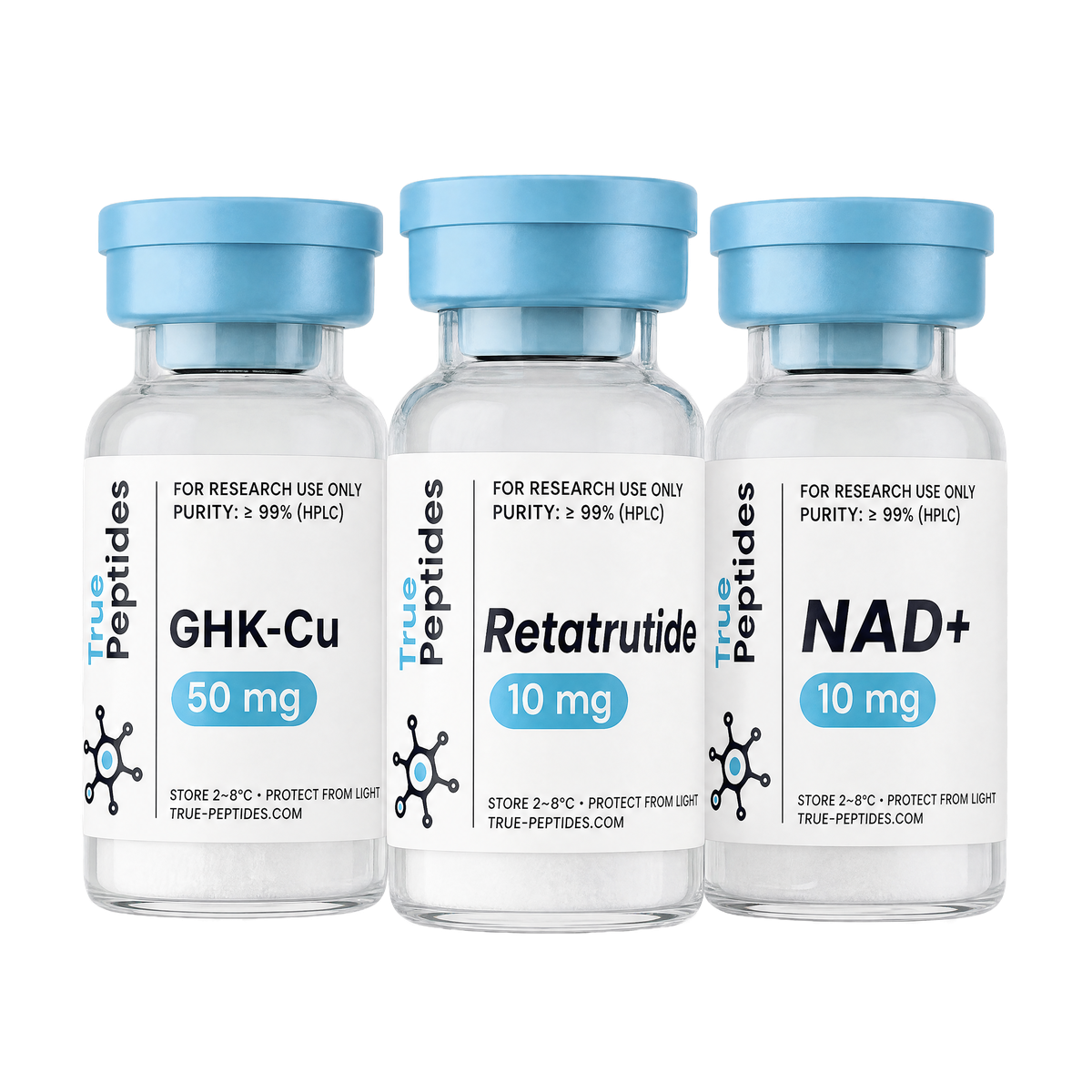
Check out our other related articles!
Frequently Asked Questions (FAQs)
What is the purpose of lyophilization in peptide preparation?
Lyophilization, or freeze-drying, is used to stabilize peptides by removing water, thereby preserving their structural integrity, reducing degradation, and extending shelf life during storage and transport.
Freeze-drying is also done in many industries for the same purpose, including in food and cosmetics.
Why should peptides be reconstituted gently?
Peptides, even when lyophilized, are sensitive and need gentle handling and processing to prevent structural disruption and aggregation.
Agitation, whether by shaking or other means, may compromise their molecular integrity, affecting the experiment’s consistency.
What factors influence successful peptide reconstitution?
Successful reconstitution of peptides depends on the factors we have mentioned above, including proper use of solvents, proper concentration calculation, sterile handling conditions, and proper storage before and after.
Environmental factors such as pH, temperature, oxygen, and light exposure will also affect the peptide’s stability.
DISCLAIMER: Products sold by True Peptides are intended for laboratory and research use only. They are not drugs, food, or dietary supplements, and are not intended to diagnose, treat, cure, or prevent any disease. Not for human or animal consumption.
REFERENCES:+
- Wiktoria Brytan, Luis Padrela, Structural modifications for the conversion of proteins and peptides into stable dried powder formulations: A review, Journal of Drug Delivery Science and Technology, Volume 89, 2023, 104992, ISSN 1773-2247, https://doi.org/10.1016/j.jddst.2023.104992.
- H.A. Schiffter, 5.41 – Pharmaceutical Proteins – Structure, Stability, and Formulation, Editor(s): Murray Moo-Young, Comprehensive Biotechnology (Second Edition), Academic Press, 2011, Pages 521-541, ISBN 9780080885049, https://doi.org/10.1016/B978-0-08-088504-9.00468-2.
- Jameson C (2024). Benefits of Lyophilization: Revolutionizing Pharmaceuticals and Food Preservation. J Mass Spectrom Purif Tech. 10:266.
- Jiang H, Zhang N, Xie L, Li G, Chen L, Liao Z. A Comprehensive Review of the Rehydration of Instant Powders: Mechanisms, Influencing Factors, and Improvement Strategies. Foods. 2025 Aug 20;14(16):2883. doi: 10.3390/foods14162883. PMID: 40870794; PMCID: PMC12385211.
- Sarma R, Wong KY, Lynch GC, Pettitt BM. Peptide Solubility Limits: Backbone and Side-Chain Interactions. J Phys Chem B. 2018 Apr 5;122(13):3528-3539. doi: 10.1021/acs.jpcb.7b10734. Epub 2018 Feb 13. PMID: 29384681; PMCID: PMC5909690.