

KEY TAKEAWAYS: Research peptides must be stored and reconstituted properly when used in laboratory settings. Avoid contamination by following safety protocols, including wearing PPE. Keep a detailed log and label each peptide properly to ensure study reproducibility and traceability, and practice safe disposal when done. True Peptides is the best place to buy peptides for research purposes.
DISCLAIMER: This article is for informational and educational purposes only. All products referenced are sold strictly for laboratory and research use by qualified professionals. Not for human consumption, veterinary use, or diagnostic use.
Research peptides are typically lyophilized (freeze-dried) and then powdered to ensure stability during storage, transportation, and pre-laboratory use. However, they remain sensitive and prone to degradation, especially when handled improperly or when exposed to harmful elements.
As peptide sciences grow in popularity among researchers for their potential applications in pharmaceutical development and biomedical research contexts, the demand for research peptides has also grown exponentially over the years.
Finding the best place to buy peptides is crucial for obtaining consistent, high-purity compounds that can improve the accuracy and reproducibility of study results.
In this guide, we’ll discuss best practices and standards when working with research peptides for laboratory use, as well as the importance of sourcing them from reliable suppliers.
What Are Research Peptides?
Peptides are made up of amino acid chains linked by peptide bonds that are often found in the body, in foods, or synthetically. Amino acids are the building blocks of both proteins and peptides; however, peptides are shorter, containing 2-50 amino acids, while proteins contain a standard 20 amino acids.
Research peptides are specifically used in controlled laboratory settings, often in lyophilized or freeze-dried form, for receptor-binding studies, metabolic pathways research, and drug development.
The increasing relevance of research peptides in peptide sciences, particularly in preclinical and translational research, makes them a goldmine for medical and health-related research.
They are studied for their receptor-specific binding properties in various research applications.
Best Practices for Handling Research Peptides
1. Storage and Stability
Lyophilized peptides must be stored at -20°C for short-term storage or -80°C for long-term storage.
While generally stable, powdered research peptides are still sensitive to light, particularly those containing sensitive amino acids, such as Cys, Met, Trp, and Tyr. Protect them from light by using amber vials or covering them with aluminum foil.
While lyophilized peptides are freeze-dried and powdered, they can still absorb moisture from the air, leading to degradation or dissolution in absorbed water. Prevent this from happening by storing the peptides in a dessicator or a dessicated environment.
Frozen peptides tend to condensate when opened straight from the freezer. It’s best to allow the vial to reach room temperature first before opening to prevent degradation.
READ MORE: How to Store Peptides for Long-Term Research Use
2. Reconstitution Protocols
Sterile solvents and proper dilution techniques are important when reconstituting lyophilized research peptides to avoid contamination and degradation.
Use sterile, high-purity water, phosphate-buffered saline, or another buffer suited to the downstream assay. Record the solvent, concentration and preparation date with the sample.
Gentle mixing is necessary to prevent peptide chain breakage. Gently swirl, invert, ot use a sonicator to completely dissolve the powder.
Reconstituted peptides are much less stable than the powdered form. They have to be used immediately or divided into single-use aliquots or small sample sizes before refreezing at -20°C to -80°C.
Repeated freeze-thaw cycles can accelerate their degradation and loss of integrity and biological activity, as each cycle introduces physical and chemical stress that can break peptide bonds.
READ MORE: How to Reconstitute Peptides for Laboratory Use
3. Laboratory Handling and Contamination Prevention
A contaminated peptide is unusable and unsafe. To prevent contamination, proper laboratory equipment and sterile techniques are essential, including the use of personal protective equipment (PPE), such as gloves, lab coats, and goggles.
The work environment must also be cleaned and sterilized before and after use.
Lyophilized peptides are still prone to adsorption, so using a proper, low-binding plastic tube or glass vials for storage is a must. Low-grade plastic vials may cause peptide loss due to adhesion to plastic, especially for low-concentration solutions.
Also, when opening, be careful not to lose peptide powder due to vacuum pressures and aerosolization.
4. Documentation and Quality-Control
Record keeping and maintaining detailed logs of all compounds are also important best practices when working with research peptides for laboratory use. This can include storage conditions and usage.
Clearly label all vials with the peptide name, lot number, concentration, date of reconstitution, and solvent used.
Documentation and batch tracking will help connect a specific experiment to a specific production lot’s Certificate of Analysis (COA). This way, researchers can differentiate organic biological results from results caused by inconsistencies in compound purity, mass, or degradation.
The purity of research peptides is typically >75% to >99%, but even slight changes in purity can significantly affect research results.
With True Peptides, clients are assured of 99%+ purity and accurate sequence, as verified by our COA, High-Performance Liquid Chromatography (HPLC), and Mass Spectrometry (MS) reports. Every lot is tested by third-party laboratories, ensuring consistent, high-quality results in every batch.
5. Safety and Disposal
True Peptides’ research peptides are intended for in vitro or laboratory research purposes only. They are not FDA-approved for human consumption or clinical use.
Disposing of unused compounds and materials should be done through approved chemical waste channels rather than in regular trash. The tools used for reconstitution should be in a puncture-resistant, labeled, and FDA-cleared sharps container.
Always adhere to institutional policies regarding environmental health and safety regulations for chemical and biohazardous waste disposal.
And lastly, decontamination is also a must after every handling of peptides. Use 70% ethanol or other appropriate solvents to disinfect surfaces and tools.
Core Quality Standards in Peptide Research
Research Peptide’s Purity and Analytical Testing
Peptized for laboratory use must always have a COA with MS and HPLC validation to verify the peptide’s identity, purity, and composition.
This is important for verifying authenticity and ensuring research reliability.
The Certificate of Analysis must contain:
- Batch and lot numbers
- Testing dates, signatures, and accreditation
- The peptide’s molecular identity analysis
- Compound purity measurement
- Presence of impurities
- Analytical methods used to get the results
- Description of the physical characteristics
- The third-party laboratory’s verification/ additional test result
See our research peptides for sale’s Certificates of Analysis here!
Manufacturing Standards
Research-grade peptides, often labeled as Research-Use Only (RUO), require minimal regulatory oversight because they are intended only for laboratory and research use. On the other hand, those approved for clinical and therapeutic applications must comply with Current Good Manufacturing Practices (CGMP) and the strict FDA regulations.
However, research peptides are now increasingly held to higher analytical standards to ensure consistency and reproducibility in scientific results.
High-quality RUO peptides are not required, but in compliance with best practices, still voluntarily adhere to the principles outlined in ICH Q6B guidelines for test procedures and criteria for biotech products, as well as USP Reference Standards that ensure consistency through validated methods.
RELATED: How to Optimize Peptide Solubility for Experimental Use
Why True Peptides Is the Best Place to Buy Peptides
True Peptides is committed to meeting the high standards expected in peptide sciences and laboratory research. Our high-purity research peptides at 99%+ are supported by analytical verification from our manufacturers and third-party testers.
Every lot of our compounds is tested; not spot checked, not randomly sampled.
Customers can expect:
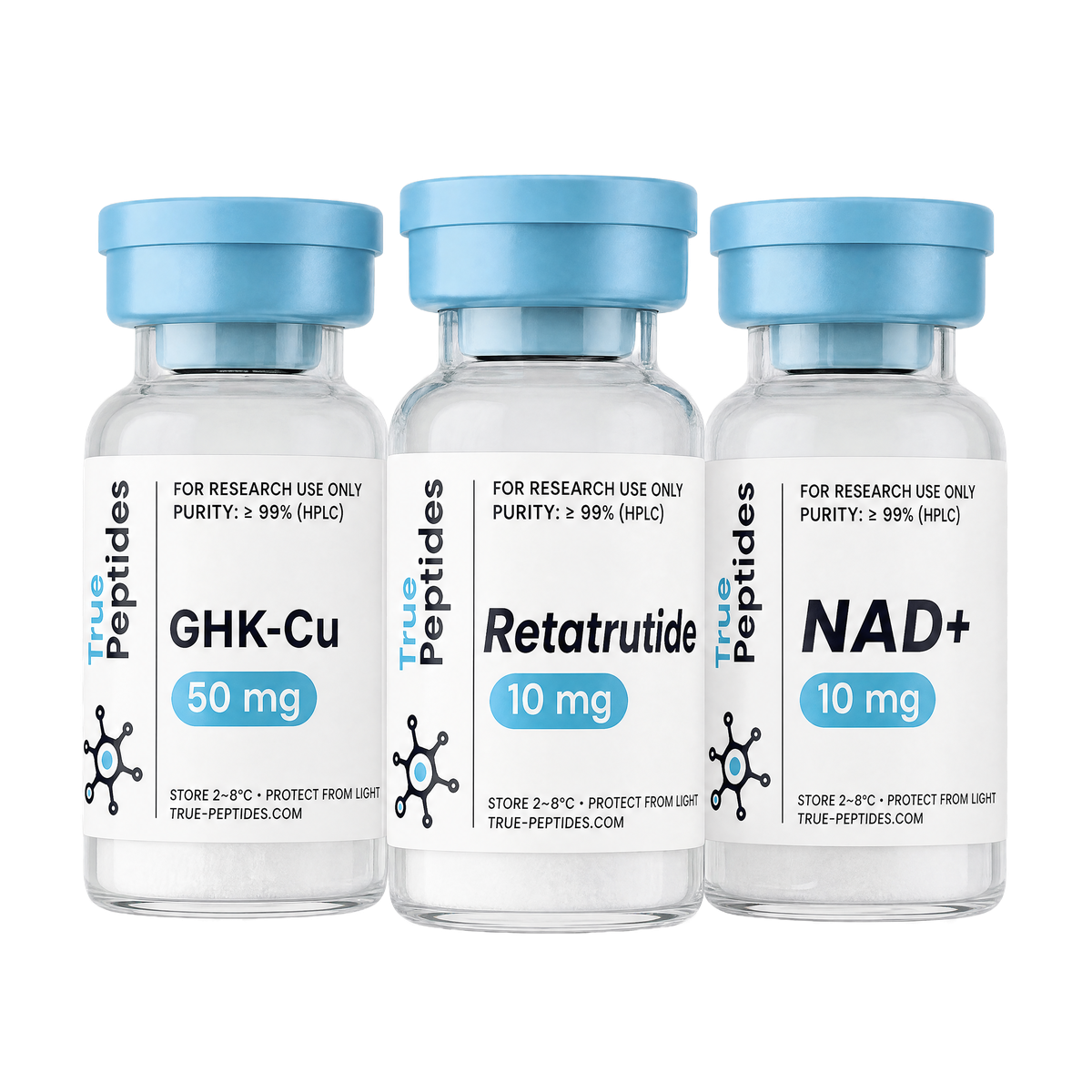
- Properly labeled vials with a unique lot number for easy tracking. This lot number is linked to the purity percentage, documented quantity, and a Certificate of Analysis, which clients can check on the product page before ordering.
- Full matching documentation. Each lot gets its own paperwork and testing. No recycled COAs.
- Full traceability. Every vial, COA, and test result is linked together. Customers can trace any product back to its lot, its test data, and its source documentation.
True Peptides maintains our transparency and integrity by providing high-quality research peptides that researchers can trust. We ship orders placed before 2 PM PST, and our support team is just an email away to assist with any queries.
Check out our most popular research peptides here:
Learn more about our retatrutide peptides for sale:
Frequently Asked Questions (FAQs)
What distinguishes research peptides from therapeutic peptides?
Research peptides, such as those we offer at True Peptides, are synthesized for experimental and laboratory use only. They are not approved for clinical application and human use. Therapeutic peptides, on the other hand, are developed for medical and veterinary use and undergo strict regulatory evaluations to be deemed safe.
Why is peptide purity critical in laboratory studies?
A highly pure peptide contributes to the accuracy and reproducibility of experimental results because the compound is exactly what it should be.
In contrast, a highly impure peptide, one that contains impurities, synthesis byproducts, and/or other material that is not the peptide, can interfere with biological interactions in the study, leading to inconsistent or misleading outcomes.
How were research peptides typically stored to maintain stability?
Research peptides are mostly stored in lyophilized (powdered, freeze-dried) form at low temperatures to prevent degradation; however, some are also stored in reconstituted form, but are less stable.
Regardless of the form, research peptides must always be stored at or below -20°C to avoid degradation and preserve their molecular integrity.
What analytical methods were used to verify peptide quality?
Common techniques for verifying peptide quality include HPLC and mass spectrometry, the same standard methodologies used for True Peptides’ research peptide.
High-performance liquid chromatography (HPLC) separates, identifies, and quantifies components of a liquid sample, while mass spectrometry identifies and quantifies molecules in a sample by measuring their mass-to-charge ratio.
Both methods are necessary for assessing the peptide’s purity and confirming its molecular identity.
DISCLAIMER: Products sold by True Peptides are intended for laboratory and research use only. They are not drugs, food, or dietary supplements, and are not intended to diagnose, treat, cure, or prevent any disease. Not for human or animal consumption.
REFERENCES+
- Accardo A, Aloj L, Aurilio M, Morelli G, Tesauro D. Receptor binding peptides for target-selective delivery of nanoparticles encapsulated drugs. Int J Nanomedicine. 2014 Mar 27;9:1537-57. doi: 10.2147/IJN.S53593. PMID: 24741304; PMCID: PMC3970945.
- Mamoudou Hamadou, Bioactive peptides and metabolic health: a mechanistic review of the impact on insulin sensitivity, lipid profiles, and inflammation, Applied Food Research, Volume 5, Issue 2, 2025, 101056, ISSN 2772-5022, https://doi.org/10.1016/j.afres.2025.101056.
- Wang L, Wang N, Zhang W, Cheng X, Yan Z, Shao G, Wang X, Wang R, Fu C. Therapeutic peptides: current applications and future directions. Signal Transduct Target Ther. 2022 Feb 14;7(1):48. doi: 10.1038/s41392-022-00904-4. PMID: 35165272; PMCID: PMC8844085.
- Mant CT, Chen Y, Yan Z, Popa TV, Kovacs JM, Mills JB, Tripet BP, Hodges RS. HPLC analysis and purification of peptides. Methods Mol Biol. 2007;386:3-55. doi: 10.1007/978-1-59745-430-8_1. PMID: 18604941; PMCID: PMC7119934.
- Vicki H. Wysocki, Katheryn A. Resing, Qingfen Zhang, Guilong Cheng, Mass spectrometry of peptides and proteins, Methods, Volume 35, Issue 3, 2005, Pages 211-222, ISSN 1046-2023, https://doi.org/10.1016/j.ymeth.2004.08.013.
- ICH Harmonised Tripartite Guideline, Specifications: Test Procedures and Acceptance Criteria for Biotechnological/Biological Products Q6B, Current Step 4 Version, 1999 Mar 10
- U.S. Pharmacopeia, Pharmacopeial Reference Standards and Pharmacopeial Documentary Standards Method (USP Reference Standards)