
How to Store Peptides for Long-Term Research Use

KEY TAKEAWAYS: Lyophilized peptides must be stored at -20°C or -80°C for long-term storage and -2°C to -4°C for short-term storage. Keep them away from light, high temperatures, and moisture to avoid degradation. Reconstituted peptides must be aliquoted to avoid freeze-thaw cycles.
DISCLAIMER: This article is for informational and educational purposes only. All products referenced are sold strictly for laboratory and research use by qualified professionals. Not for human consumption, veterinary use, or diagnostic use.
While most research-grade peptides for sale are stable for short-term handling and transportation, they remain chemically delicate and require proper storage to preserve their structural integrity and bioactivity.
Storage conditions can affect a peptide’s degradation, stability, and reproducibility, thereby influencing the conclusions of a study or experiment. They serve as critical tools in advancing peptide science, particularly in biotechnology, pharmacology, and molecular biology, all of which crucially rely on successful laboratory work.
In this guide, we’ll discuss how to store peptides for long-term research use, along with handling protocols and common mistakes when working with peptides in a laboratory setting.
What Are Research Peptides and Why Does Storage Matter
Research peptides are short chains of amino acids used in biological research for studying cellular pathways, receptor binding, and molecular biology. They help researchers understand biological mechanisms to develop new diagnostic or therapeutic tools.
While they are not for human consumption or clinical use, research peptides need proper handling to preserve their structural integrity and overall efficacy. They are susceptible to degradation, especially when exposed to various elements or contaminants, such as oxygen (oxidation), water (hydrolysis), and pathogens, such as bacteria, viruses, fungi, or parasites (microbial contamination).
Inappropriate storage and exposure to any of these can affect the peptide’s potency, leading to loss of biological activity and potentially resulting in faulty experimental data.
Research peptides can be categorized into two forms: lyophilized and reconstituted, each having its own storage requirements.
RELATED: Research Peptides for Laboratory Use: Best Practices and Standards
How to Store Peptides: Lyophilized or Freeze-Dried Peptides
Peptides that are freeze-dried and powdered are called lyophilized peptides. The peptide solution is placed in a specialized refrigeration system at -40°C to enter a frozen state, then undergoes sublimation under vacuum to remove the water.
The primary drying removes about 95% of the water content, and a second drying removes the residual moisture, producing a stable powder. Lyophilized research peptides are common in pharmaceutical, research, and cosmetic applications.
This rigorous yet delicate process converts the peptides into a stable form that enables easy transport and long-term storage. They are designed to be rehydrated (reconstituted) to activate upon use.
Temperature
For long-term, archival storage, lyophilized peptides should be stored in a freezer at -20°C or -80°C.
Peptides stored at -20°C reportedly can last 1 to 3 years, while those stored at -80°C can last 10+ years, provided they are stored in an airtight container and in a dark place.
For short-term storage, peptides scheduled for experiments within a few weeks can be stored safely at -2°C to -4°C. Depending on the peptide sequence, those stored at this temperature can last 6 to 24 months; however, peptides containing cysteine (Cys), methionine (Met), or tryptophan (Trp) may have a shorter lifespan, as they are more susceptible to oxidation.
It’s also possible to store lyophilized peptides at room temperature under controlled environmental conditions, but they can only last for days to weeks before degradation starts.
Moisture Protection
Lyophilized peptides are highly hygroscopic, which means they attract and absorb moisture when exposed to air. This can cause the powdered form to become gel-like, damp, sticky, or clumped, resulting in reduced stability and potency. When used in research, this can also lead to inaccurate weighing.
Storing peptides in a sealed container is always a must to prevent hydrolysis. Using a desiccator or desiccant packs will also help prevent moisture absorption.
Light Protection
Peptides, even in their lyophilized form, are prone to photodegradation. Exposure to UV light can cause structural breakdown and affect their potency. One sign of peptide degradation due to light exposure is discoloration, with the powder turning yellow or becoming cloudy.
To prevent this, lyophilized peptides should be stored in opaque containers or bags, in their original dark containers or bags.
Placing them in opaque, amber-colored vials will also help minimize UV exposure. If in a clear vial, cover them with aluminum foil for an extra layer of protection.
Having a dedicated, dark freezer for peptides is also recommended to eliminate their exposure to ambient light.
Oxygen Exposure
While lyophilized peptides are considered stable, they are still chemically fragile. Exposure to oxygen can generate free radicals that can break the peptide chain and affect its efficacy, possibly rendering it useless.
Peptides that contain cysteine (Cys), methionine (Met), or tryptophan (Trp) are especially prone to oxidation due to their amino acid side chains that contain heteroatoms, specifically sulfur or nitrogen. When they come into contact with oxygen, they can result in structural changes, loss of bioactivity, and even discoloration or browning.
To prevent oxidation, sensitive peptides must be stored in airtight containers, purged of oxygen with nitrogen or argon gas, a process known as “inerting” or “blanketing.”
Peptides must also be stored in the smallest vial possible to minimize the air space. They must also be aliquoted into smaller, single-use vials to avoid repeated freeze-thaw cycles.
Handling and Transportation
Before opening for use, the vial must reach room temperature in its sealed container or in a desiccator to prevent condensation, which can introduce moisture and degrade the peptides.
Researchers must always wear personal protective equipment, such as gloves and a dust respirator, especially when handling large amounts of lyophilized peptides.
When transported as powders, peptides are typically stable at room temperature and can withstand it for days or weeks. However, for longer transit times, it is recommended to be shipped on dry ice to minimize exposure to high temperatures.
When traveling with small aliquots, storing them in a medical-grade cold pack or in any insulated shipping container is recommended. Freeze or chill at -2°C to -80°C as soon as possible to preserve their potency and lifespan.
How to Store Peptides: Reconstituted (Liquid) Peptides
Reconstituted peptides, also known as peptide solutions or liquid-phase peptides, are freeze-dried peptides dissolved in a solvent to activate them for use.
Because a form of water (sterile water or assay buffer) has been introduced into the powdered peptides, it can increase the likelihood of chemical and physical reactions, and therefore, their susceptibility to degradation. Reconstituted peptides are functionally more volatile than lyophilized ones.
Temperature
The recommendation for storing reconstituted peptides is similar to that for lyophilized peptides: at -20 °C or -80 °C for long-term storage, and at 2 °C to 8 °C for short-term storage. However, their lifespans differ, even under proper storage conditions.
Whereas a freeze-dried one can last for years or a decade, a peptide solution can last only 3 to 4 months at -20°C or up to 1 year at -80°C.
Reconstituted peptides should never be stored at room temperature, as they are more prone to degradation, hydrolysis, and microbial growth. However, they can stand room temperatures for short-term handling, typically for hours.
If the peptide must be used frequently, small portions or aliquots can be stored at 4°C instead of at room temperature. This can last for days or weeks without affecting the peptides’ potency.
Avoid Freeze-Thaw Cycle
Repeated freezing and thawing of peptides, whether lyophilized or reconstituted, can affect their structural integrity and quality. The buffer or solvent used in the reconstitution may also influence how the freeze-thaw cycle can affect the peptides.
Specific buffers, such as PBS, HBS, and acidic solutions, are generally considered poor choices for long-term storage, as their pH shifts with freezing and may cause the peptide to denature or precipitate. The best option for these buffered solutions may be flash-freezing, to not give enough time for crystals to form and solutes to concentrate.
Peptides dissolved in sterile water or assay buffer are generally stable for freezing and a single thaw.
To avoid the freeze-thaw cycle, divide a large batch of peptides into aliquots or single-use vials. Store the amount needed at 4°C and use it within a couple of days or weeks, while the rest of the peptides for long-term research can be stored at -20 °C or colder.
Avoid Light & Oxygen Exposure
Reconstituted peptides are best stored in opaque or amber-colored vials, sealed and air-tight, in a dedicated dark, dry freezer to minimize or avoid light and oxygen exposure altogether.
The vials can also be wrapped in aluminum foil as an added protection, especially when clear and not opaque.
The introduction of UV light and oxygen can affect diluted peptides faster than it can the freeze-dried ones, as the presence of water molecules in the reconstituted ones can promote hydrolysis and photodegradation, leading to a faster breakdown of the peptide structure.
Also, peptide solutions with Cys, Met, or Trp residues are sensitive and may require storage with nitrogen or argon.
When reconstituting a peptide, one best practice is to avoid shaking, as it can introduce foam and air bubbles. Instead, gentle swirling of the vial or using an ultrasonicator is more ideal for dissolving peptides in solvents.
Transportation
Ideally, reconstituted peptides should not be transported in this state. The best way to do it is with the lyophilized ones.
However, if absolutely necessary, reconstituted peptides must be packaged in sealed, leak-proof vials and placed inside a secondary container to prevent contamination and damage. They should also be transported as rapidly as possible, on dry ice, to maintain a temperature between 2° C and 8° C.
RELATED: How to Reconstitute Peptides for Laboratory Use
Signs of Degradation in Research Peptides
There are physical and analytical indicators of degradation in research peptides.
For one, a degraded lyophilized peptide may look clumped (aggregated), sticky, or discolored (yellowing or browning). Reconstituted ones may also look discolored, cloudy, hazy, or have visible particles.
Unusual behavior or loss of solubility are also common indicators of peptide degradation. Powdered ones that previously dissolved easily may become harder to dissolve, indicating structural breakdown.
Some may also give off unexpected odors or visible microbial growth, which are clear signs of contamination, especially when not stored properly.
In laboratories, degraded peptides may also lead to unreliable or inconsistent results due to the unpredictable biological activity.
Chemical changes may also occur, which can be confirmed by HPLC or mass spectrometry. Peptides past their prime may show new peaks, lower purity, or altered molecular weight due to oxidation, hydrolysis, or fragmentation.
These changes are commonly linked to exposure to heat, moisture, light, oxygen, or repeated freeze–thaw cycles, all of which accelerate peptide degradation.
More Important Storage Tips for Research Peptides
- Use suitable vials, preferably sterile and nonreactive, to avoid adsorption, in which peptide molecules stick to the glass or plastic container, thereby reducing the solution’s concentration from 60% to 90%.
- Do not forget to track the batch number, dates, and concentrations, especially when storing peptides for long-term research use. This is important for reproducibility and traceability.
- Avoid storing sensitive peptides in auto-defrost freezers because of their cyclic temperature fluctuations, which can subject the peptides to unintentional freeze-thaw cycles.
- Always abide by the manufacturer-provided storage recommendations typically found in the Certificate of Analysis. There should be a dedicated “Storage,” “Stability,” or “Handling” section in the COA, complete with specific, batch-level information on optimal temperatures, light protection, and moisture control, among other factors.
- Choose a reliable supplier for research peptides. There should be consistency and quality control in manufacturing, as well as transparency, testing standards, and complete documentation.
Why True Peptides Is the Best Place to Buy Peptides
True Peptides is committed to meeting the high standards expected in peptide sciences and laboratory research. Our high-purity research peptides at 99%+ are supported by analytical verification from our manufacturers and third-party testers.
Every lot of our compounds is tested; not spot checked, not randomly sampled.
Customers can expect:
- Properly labeled vials with a unique lot number for easy tracking. This lot number is linked to the purity percentage, documented quantity, and a Certificate of Analysis, which clients can check on the product page before ordering.
- Full matching documentation. Each lot gets its own paperwork and testing. No recycled COAs.
- Full traceability. Every vial, COA, and test result is linked together. Customers can trace any product back to its lot, its test data, and its source documentation.
True Peptides maintains our transparency and integrity by providing high-quality research peptides that researchers can trust. We ship orders placed before 2 PM PST, and our support team is just an email away to assist with any queries.
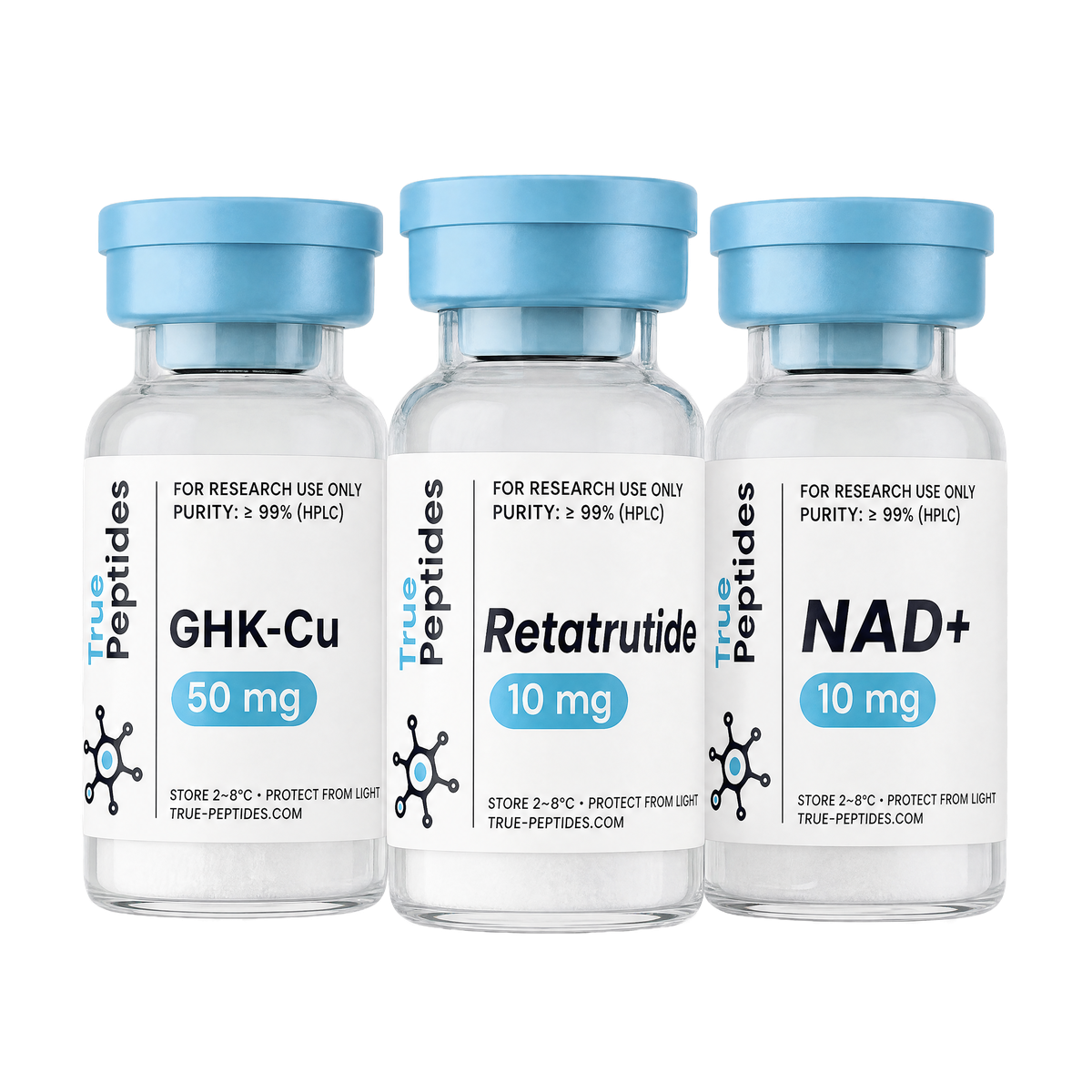
Learn more about our popular research peptides here:
Frequently Asked Questions
What is the best way to store lyophilized peptides long-term?
Freeze-dried peptides must always be stored at -20°C or lower and in a sealed, moisture-free container (ideally with desiccants). Peptides should always be kept in a dark, dry place and in amber-colored or opaque vials that are ideally low-binding to avoid adsorption.
Under these conditions, the peptides are expected to last for years with slowed degradation and minimal chemical or physical reactions.
How do storage conditions affect peptide stability?
Lyophilized and especially reconstituted peptides are both delicate and highly sensitive to temperature, moisture, light, and oxygen exposures. Coming into contact with these elements can significantly reduce peptides’ purity by affecting their structural integrity and bioactivity, potentially leading to unreliable research outcomes.
Can reconstituted peptides be stored for extended periods?
The most extended period one can hope for when storing reconstituted peptides is about 6 to 12 months at -80°C. Reconstituted peptides are less stable than freeze-dried peptides, so they should ideally be used promptly or aliquoted into single-use vials to minimize handling and degradation.
Check out more of our recommended and related articles below!
- The Ultimate Guide to Research-Grade trizep
- The Ultimate Guide to Retatrutide for Research Use
- How to Optimize Peptide Solubility for Experimental Use
DISCLAIMER: Products sold by True Peptides are intended for laboratory and research use only. They are not drugs, food, or dietary supplements, and are not intended to diagnose, treat, cure, or prevent any disease. Not for human or animal consumption.
REFERENCES+
- Nugrahadi, P.P., Hinrichs, W.L.J., Frijlink, H.W., Schöneich, C., & Avanti, C. (2023, March 28). Instability of Peptide and Possible Causes of Degradation. In Encyclopedia. https://encyclopedia.pub/entry/42582
- Darrington, Rob. (2024). Re: `Does freeze-thaw effect will have an impact on the peptide’s stability?. Retrieved from: https://www.researchgate.net/post/Does_freeze_thaw_effect_will_have_an_impact_on_the_peptides_stability/661641578e31eb7875037598/citation/download.
- Kristensen K, Henriksen JR, Andresen TL. Adsorption of cationic peptides to solid surfaces of glass and plastic. PLoS One. 2015 May 1;10(5):e0122419. doi: 10.1371/journal.pone.0122419. PMID: 25932639; PMCID: PMC4416745.
- Andrés, C. M. C., Pérez de la Lastra, J. M., Andrés Juan, C., Plou, F. J., & Pérez-Lebeña, E. (2022). Impact of Reactive Species on Amino Acids-Biological Relevance in Proteins and Induced Pathologies. International journal of molecular sciences, 23(22), 14049. https://doi.org/10.3390/ijms232214049
- Akhilesh Kumar Kuril* and Ankur Vashi. Identifying Trending Issues in Assay of Peptide Therapeutics During Stability Study. Am J Biomed Sci & Res. 2024 – 22(4). AJBSR.MS.ID.002974. DOI:10.34297/AJBSR.2024.22.002974
- http://airproducts.ie/campaigns/the-importance-of-inerting
- https://manufacturingchemist.com/freeze-drying-producing-stable-peptides-206036
- https://www.sciencedirect.com/topics/immunology-and-microbiology/high-performance-liquid-chromatography-mass-spectrometry