

DISCLAIMER: This article is for informational and educational purposes only. All products referenced are sold strictly for laboratory and research use by qualified professionals. Not for human consumption, veterinary use, or diagnostic use.
Retatrutide is a synthetic triple-receptor agonist peptide that targets GIP, GLP-1, and GCG (glucagon) receptors. Whereas trizep is a dual-receptor agonist targeting GLP-1 and GIP, retatrutide adds glucagon receptor activity, broadening its receptor binding profile compared to earlier incretin-based compounds.
This guide summarizes everything to know about retatrutide for research use, including its chemistry, receptor binding mechanism, and proper laboratory handling.
What is Retatrutide and How Does It Work?
Retatrutide is a synthetic peptide classified as a triple hormone receptor agonist that targets GLP-1, GIP, and GCG receptors. It belongs to a newer category of incretin-based investigational peptides studied in laboratory and preclinical research settings.
Unlike single-receptor agonists (e.g., sema, targeting GLP-1) and dual-receptor agonists (e.g., trizep, targeting GLP-1 and GIP), retatrutide simultaneously engages three receptor subtypes, providing a unique receptor binding profile for in-vitro characterization studies.
Retatrutide consists of 39 amino acids in a linear chain, with specific substitutions and synthetic modifications, and was intentionally engineered to combine receptor binding activity across three distinct hormonal pathways (GLP-1, GIP, and GCG) into a single molecule.
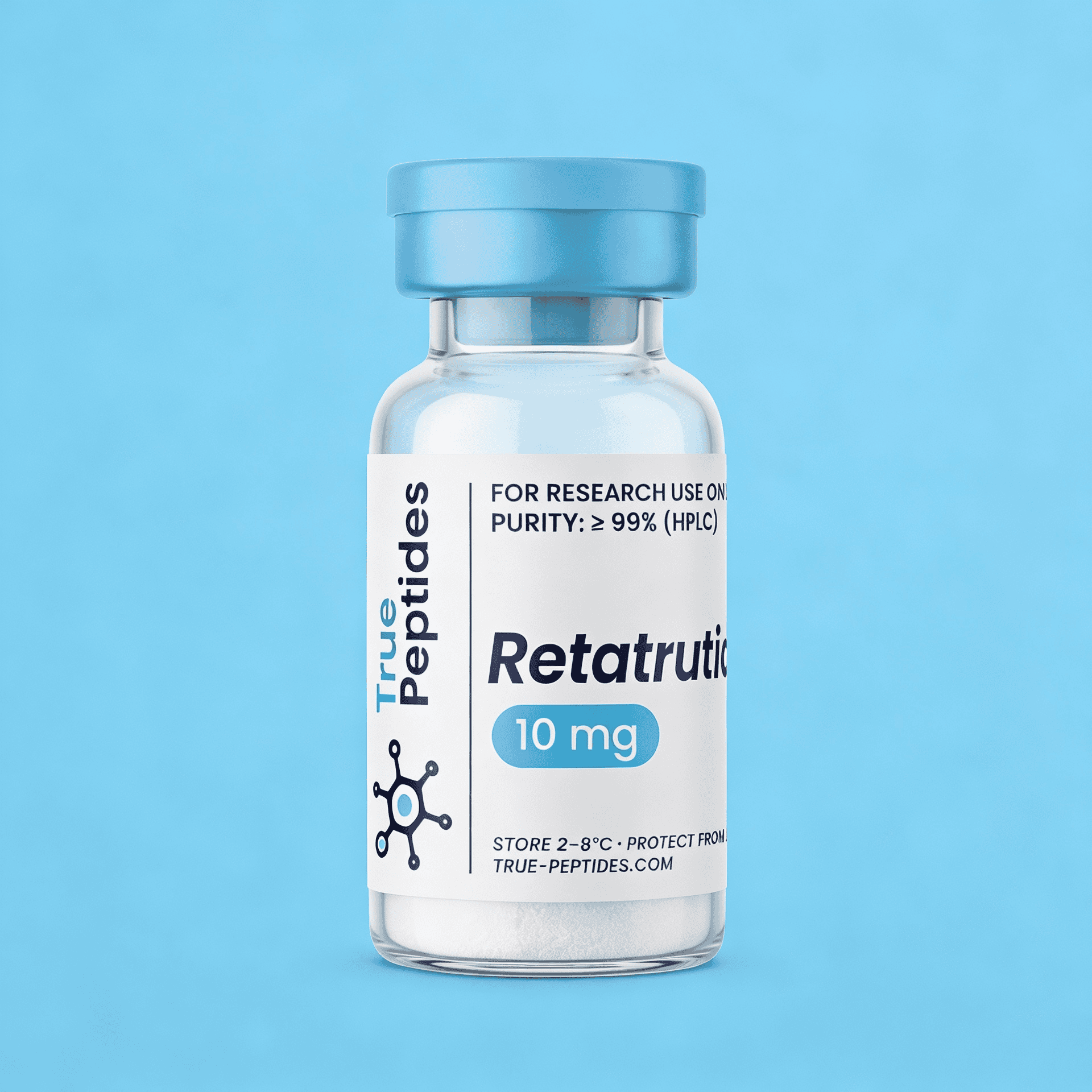
RETATRUTIDE
Molecular Formula: C₂₀₆H₃₁₂N₄₈O₆₃S
Molecular Weight: 4483.54 g/mol
Amino Acid Sequence: His-Aib-Glu-Gly-Thr-Phe-Thr-Ser-Asp-Leu-Ser-Lys-Gln-Leu-Glu-Glu-Glu-Ala-Val-Arg-Leu-Phe-Ile-Glu-Phe-Leu-Leu-Gly-Lys-Gly-Gly-Pro-Ser-Ser-Gly-Ala-Pro-Pro-Pro-Ser
Important Note: True Peptides’ retatrutide peptide for sale is NOT intended for human or clinical use. It is only approved for laboratory and experimental use.
Regulatory Status of Retatrutide
As of this writing, the Food and Drug Administration has not issued any approvals for medications containing retatrutide, and multiple clinical investigations remain ongoing. Retatrutide is currently classified as an investigational compound.
For the latest information on the regulatory status and registered studies involving retatrutide, researchers can consult the ClinicalTrials.gov registry.
True Peptides supplies retatrutide strictly for in-vitro laboratory research. It is not intended for human or animal use.
Best Practices for Handling Retatrutide for Research Use
Correct handling, storage, and reconstitution will preserve retatrutide’s biological activity, which can directly impact an experiment’s results.
How to Store Research Retatrutide
Lyophilized retatrutide must be stored at -20ºC to -80ºC for long-term storage, or at -2ºC to -8ºC for short-term storage (under 4 weeks). The environment should be completely dry, in a desiccator or with desiccant packs, and should be away from light.
Frozen vials must be brought to room temperature before opening to prevent moisture buildup that can affect the peptide’s integrity. Freeze-thaw cycle should also be avoided, so it’s best to portion the peptides into small aliquots.
Reconstituted retatrutide, on the other hand, must always be stored in the refrigerator at 2ºC to 8ºC. Retatrutide contains amino acids that are sensitive to UV light; storing it in opaque containers or bags away from light will protect the compound from photo-oxidation.
Freezing may completely destroy the peptide’s integrity, so the reconstituted compounds need proper, careful storage.
How to Reconstitute Research Retatrutide
Retatrutide is commonly dissolved in Bacteriostatic water. The benzyl alcohol in BAC water acts as a preservative, inhibiting microbial growth in the compound and allowing multiple withdrawals from the same vial.
However, to reach higher concentrations, as some retatrutide compounds require for research purposes, the lyophilized retatrutide is often dissolved in an organic solvent first, such as DMSO or acetonitrile, followed by dilution into aqueous buffers
RELATED: How to Optimize Peptide Solubility for Experimental Use
Working in a sterile environment with personal protective equipment is important to prevent accidents and contamination of the compound.
The basic supplies needed are the lyophilized retatrutide, solvent, syringes, disinfectant (such as alcohol wipes), and proper disposal containers.
Introduce the solvent slowly to the peptide. Aim the needle so the solvent trickles down the inside wall of the glass rather than spraying forcefully.
Do not shake the vial; gentle swirling is recommended to prevent peptide degradation. If necessary, a sonicator may be used to improve efficiency.
Learn more about the best practices when handling, storing, and reconstituting peptides in laboratories below:
- Research Peptides for Laboratory Use: Best Practices and Standards
- How to Store Peptides for Long-Term Research Use
- How to Reconstitute Peptides for Laboratory Use
Why Trust True Peptides’ Retatrutide Peptide for Sale
True Peptides is committed to meeting the high standards expected in peptide sciences and laboratory research. Our high-purity research peptides at 99%+ are supported by analytical verification from our manufacturers and third-party testers.
Every lot of our compounds is tested; not spot checked, not randomly sampled.
Customers can expect:
- Properly labeled vials with a unique lot number for easy tracking. This lot number is linked to the purity percentage, documented quantity, and a Certificate of Analysis, which clients can check on the product page before ordering.
- Full matching documentation. Each lot gets its own paperwork and testing. No recycled COAs.
- Full traceability. Every vial, COA, and test result is linked together. Customers can trace any product back to its lot, its test data, and its source documentation.
True Peptides maintains our transparency and integrity by providing high-quality research peptides that researchers can trust. We ship orders placed before 2 PM CST, and our support team is just an email away to assist with any queries.
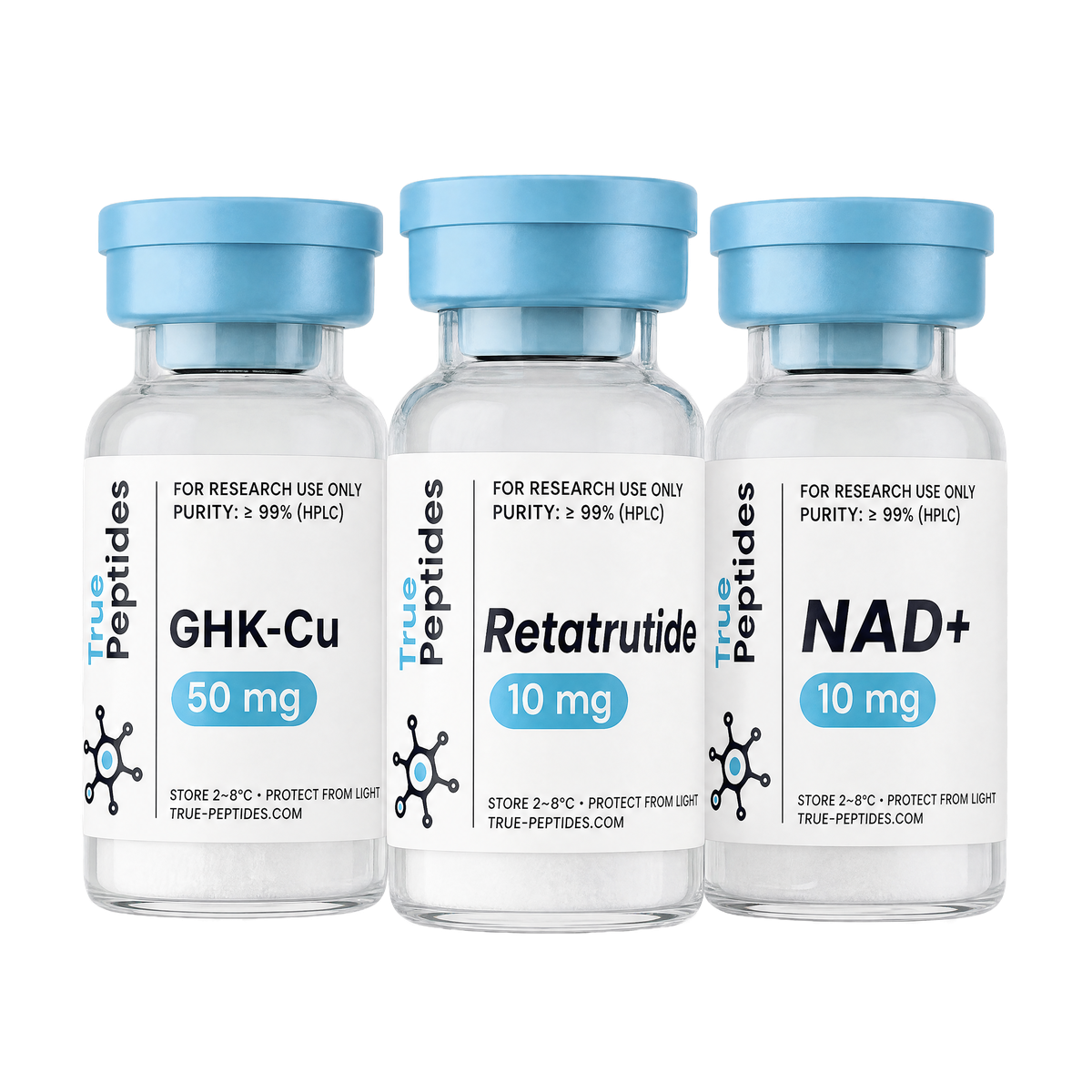
See more of our high-purity research peptides here:
FAQs About Retatrutide for Research Use
How does retatrutide differ from trizep?
Retatrutide activates three metabolic receptors (GLP-1, GIP, and glucagon), while trizep targets two (GLP-1 and GIP only).
The added glucagon receptor activity in retatrutide provides a broader receptor binding profile for in-vitro research.
Structurally, both are synthetic peptide analogs, but they differ in their receptor activity profiles and molecular designs.
Why is retatrutide supplied as a lyophilized powder?
Lyophilization (freeze-drying) improves peptide stability by removing water, which reduces degradation pathways such as hydrolysis and oxidation.
Peptides like retatrutide are more stable in dry form during shipping and long-term storage. The powder is typically reconstituted with sterile solvent prior to laboratory use.
What analytical methods are commonly used to verify retatrutide quality?
The most common methods are High-performance liquid chromatography (HPLC), used to assess purity and detect impurities, and Mass spectrometry (MS), which confirms molecular weight and structural integrity.
Additional methods such as peptide mapping, amino acid analysis, and stability testing may also be used to ensure batch consistency and quality.
DISCLAIMER: Products sold by True Peptides are intended for laboratory and research use only. They are not drugs, food, or dietary supplements, and are not intended to diagnose, treat, cure, or prevent any disease. Not for human or animal consumption.
REFERENCES+
- Retatrutide (LY3437943) compound information and receptor binding characterization. Eli Lilly and Company.
- ClinicalTrials.gov registry: https://clinicaltrials.gov/ — search "retatrutide" for current registered studies.