
DISCLAIMER: This article is for informational and educational purposes only. All products referenced are sold strictly for laboratory and research use by qualified professionals. Not for human consumption, veterinary use, or diagnostic use.
With its potential across various industries and applications, the role of research peptides has been growing exponentially in peptide science, biotechnology, and laboratory-based research.
There has also been an increasing demand for US-made research peptides in regulated environments, leading to greater availability of research peptides for sale.
This guide will discuss the different grade levels of research peptides, how to source them responsibly, and legal considerations in buying them in the United States.
What Are Research Peptides?
Peptides are amino acid chains designed to mimic and target biological processes for various purposes. They act as transmitters from the brain to the body, telling muscles and nerves to perform specific functions.
Research peptides are synthetic, lab-made, and used by researchers to explore how to study cell signaling pathways and receptor interactions in controlled laboratory settings. They are heavily regulated and may be used only in laboratory and investigational settings by law.
How Research Peptides Are Evaluated for Quality
Working with a high-quality research peptide is important for conducting accurate, reproducible experiments and for establishing reliable safety profiles. Impure or degraded peptides can compromise laboratory results and lead to invalid conclusions.
Research peptides undergo analytical testing methods, such as High-performance Liquid Chromatography (HPLC) to test purity and Mass Spectrometry to confirm identity.
A third-party laboratory conducts independent testing and validation practices using these methods to verify the peptides’ quality and summarizes their findings in a Certificate of Analysis.
See our Certificates of Analysis hereA peptide’s quality and stability are also affected by its form and storage conditions. Lyophilization and freeze storage of the peptides will ensure their longevity and integrity for long-term laboratory use.
RELATED: How to Store Peptides for Long-Term Research Use
As sema and trizep, both recognized and approved by the Food and Drug Administration for their effect on metabolic processes, incretin pharmacology, and glucose regulation, among others, researchers and stakeholders have shown interest in other synthetic peptides, with multiple clinical studies on retatrutide underway.
However, not all research peptides online are safe to administer in vivo. Most are only made for research purposes in controlled laboratory settings. This is why grade classification matters for research peptides.
Grade levels refer to the intended application of the peptide, and are influenced by the peptide purity, analytical testing, and experimental reproducibility.
They differ in purity standards, manufacturing practices, quality control, and even in required documentation and traceability. The grade level required will depend on the intended use or purpose.
Research-Use Only Peptides (Research/ Laboratory-Grade)
Research peptides, sometimes also labeled as RUO, or Research-use Only, are peptides intended only for in vitro and laboratory use. They can also be used in animal studies in controlled environments.
RUO peptides do not undergo the strict, human-grade regulatory processes that therapeutic drugs do.
There are different purity tiers for research-grade peptides:
- >95% – this is the standard or industry baseline. Peptides with purity of 95% or higher can be used for general biochemistry, quantitative analysis, cell culture experiments, and standard in vitro enzyme assays.
- >98% to >99% – this is considered high-purity peptides. Researchers can use this for in vivo animal studies and for highly sensitive biological activity assays that require a highly pure compound for accurate data.
There are also peptides with lower purity, as determined by HPLC testing, that range from 50% to 85%.
- 50% to 75% – peptides with this purity are typically tested and used exactly as they come off synthesis. Called “crude peptides,” they still contain truncated sequences and residual organic byproducts from the synthesis process. However, they can still be used for research, mostly for non-sensitive screening, sequence optimization, and large-scale peptide arrays.
- 70% to 85% – can be used in studies related to antibody production, peptide blocking, and basic ELISA testing.
Research-grade peptides also undergo detailed analysis and quality control to assess not only their purity but also their identity, the byproducts they contain (or lack), and the proportion of the desired product.
Because they are not intended for clinical use, research peptides are not required to meet Current Good Manufacturing Practice (CGMP) standards. However, they still retain high molecular purity and must be accompanied by a Certificate of Analysis (COA) issued by a third-party, unrelated laboratory that confirms their sequence identity and purity.
RELATED: Research Peptides for Laboratory Use: Best Practices and Standards
Pharmaceutical-Grade Peptides (Medical-Grade)
Pharmaceutical-grade peptides are manufactured under much stricter regulatory and CGMP standards than research-grade peptides.
Current Good Manufacturing Practice refers to the guidelines enforced by regulatory bodies such as the FDA to ensure that the biologically active component of a drug, called Active Pharmaceutical Ingredients (APIs), is consistently produced and controlled to meet the highest safety, purity, and quality standards for clinical trials and clinical use.
Some of the guidelines that must be met by peptide manufacturers include operating in a heavily regulated, ISO-certified, and GMP-compliant facility; having a robust quality unit that oversees operations, tests products, and investigates deviations or failures; having well-educated and trained personnel; and maintaining detailed standard operating procedures and master formulas.
While peptides with >50% purity can be used for research purposes, pharmaceutical-grade peptides must have a purity of >98% as measured by HPLC.
Any unknown or known impurities, even at <0.1%, must be officially reported, with a specific safety justification and confirmation from clinical and toxicological studies that they do not trigger unintended immune responses.
Medical-grade peptides, also called therapeutic peptides, are also legally prescribed by licensed healthcare providers and have been evaluated for safety, potency, efficacy, and the absence of harmful contaminants. To date, a wide variety of natural and modified peptides have been obtained and studied, covering multiple therapeutic areas.
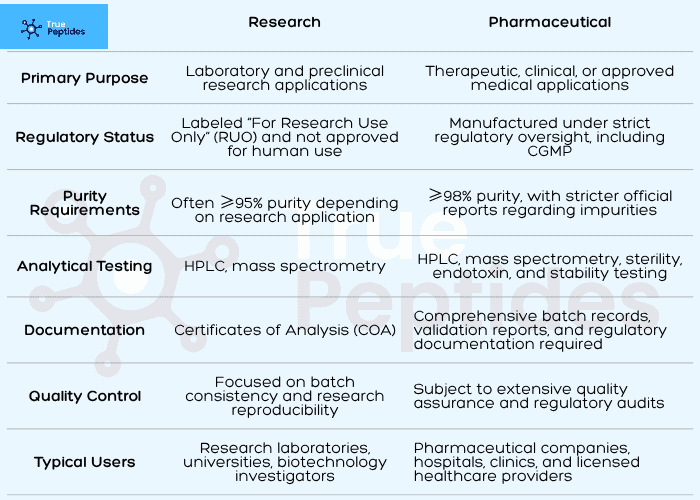
Peptide Grades Side-by-Side Comparison
Why Trust True Peptides’ US-Made Research Peptides
True Peptides is committed to meeting the high standards expected in peptide sciences and laboratory research. Our high-purity research peptides at 99%+ are supported by analytical verification from our US-based manufacturers and third-party testers.
Every lot of our compounds is tested; not spot checked, not randomly sampled.
Customers can expect:
- Properly labeled vials with a unique lot number for easy tracking. This lot number is linked to the purity percentage, documented quantity, and a Certificate of Analysis, which clients can check on the product page before ordering.
- Full matching documentation. Each lot gets its own paperwork and testing. No recycled COAs.
- Full traceability. Every vial, COA, and test result is linked together. Customers can trace any product back to its lot, its test data, and its source documentation.
True Peptides maintains our transparency and integrity by providing high-quality research peptides that researchers can trust. We ship orders placed before 2 PM PST, and our support team is just an email away to assist with any queries.
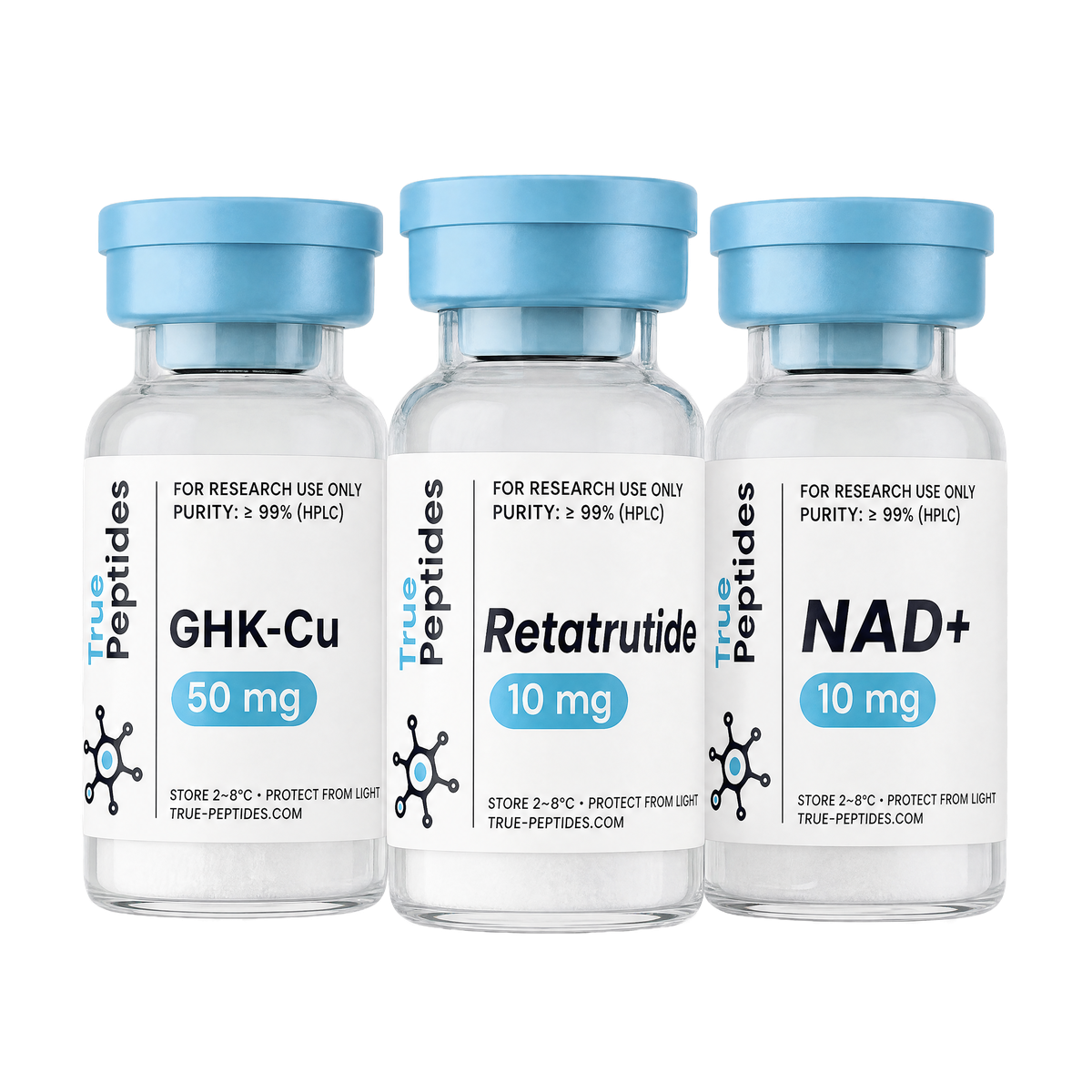
See more of our high-purity research peptides here:
Frequently Asked Questions (FAQs)
Why are US-made research peptides preferred in some laboratories?
Researchers opt for US-made research peptides because domestic manufacturing offers stricter quality control, clearer documentation, and easier traceability during procurement.
Researchers sourcing research peptides online often look for certificates of analysis (COAs), third-party testing, and compliance with established manufacturing standards when evaluating US-made research peptides.
True peptides’ RUO peptides are manufactured, tested, and shipped within the United States and comply with existing laws and regulations for quality, safety, and traceability of peptides and their documentation.
Is it legal to buy research peptides online in the USA?
In the United States, it is generally legal to buy research peptides online when they are sold strictly for laboratory and research use, not for human consumption, and when properly labeled as for “Research-Use Only.”
Researchers purchasing research peptides for sale should still verify federal and state regulations, as some compounds may face additional restrictions depending on their classification.
What should researchers evaluate before purchasing research peptides for sale?
Supplier transparency is the number one important factor when purchasing research peptides for sale. Trusted and reliable suppliers will provide all information to the researchers, including peptide purity, analytical testing methods, and storage requirements.
True Peptides provides complete documentation for every peptide, allowing researchers to carefully review it before purchase. Information about COAs, batch consistency, and shipping practices is all provided on our website and in the confirmation email we send upon purchase.
Learn more about True Peptides’ product quality and documentation, ordering & shipping policies, storage & handling, and regulatory compliance here.
Explore our other articles here!
- The Ultimate Guide to Retatrutide for Research Use
- The Ultimate Guide to Research-Grade trizep
- How to Reconstitute Peptides for Laboratory Use
DISCLAIMER: Products sold by True Peptides are intended for laboratory and research use only. They are not drugs, food, or dietary supplements, and are not intended to diagnose, treat, cure, or prevent any disease. Not for human or animal consumption.
REFERENCES+
- Linder J. (2012). The science behind peptides. Plastic surgical nursing: official journal of the American Society of Plastic and Reconstructive Surgical Nurses, 32(2), 71–72. https://doi.org/10.1097/PSN.0b013e3182577344
- Kommu S, Whitfield P. sema. [Updated 2024 Feb 11]. In: StatPearls [Internet]. Treasure Island (FL): StatPearls Publishing; 2026 Jan-. Available from: https://www.ncbi.nlm.nih.gov/books/NBK603723/
- Farzam K, Patel P. trizep. [Updated 2024 Feb 20]. In: StatPearls [Internet]. Treasure Island (FL): StatPearls Publishing; 2026 Jan-. Available from: https://www.ncbi.nlm.nih.gov/books/NBK585056/
- Wang, L., Wang, N., Zhang, W., Cheng, X., Yan, Z., Shao, G., Wang, X., Wang, R., & Fu, C. (2022). Therapeutic peptides: current applications and future directions. Signal transduction and targeted therapy, 7(1), 48. https://doi.org/10.1038/s41392-022-00904-4
- https://www.fda.gov/drugs/pharmaceutical-quality-resources/current-good-manufacturing-practice-cgmp-regulations
- https://www.polypeptide.com/wp-content/uploads/2019/10/1401702924538c4a0cb5e0a.pdf