

DISCLAIMER: This article is for informational and educational purposes only. All products referenced are sold strictly for laboratory and research use by qualified professionals. Not for human consumption, veterinary use, or diagnostic use.
A Certificate of Analysis (COA) is an important document issued for products in heavily regulated industries, including pharmaceuticals, food and beverages, chemicals, and cosmetics.
It verifies the product’s safety, legitimacy, quality, and composition, and confirms that the specific batch meets the industry requirements and specifications.
When buying peptides online, the COA should always be checked and verified. It must contain empirical data provided and tested for by a legitimate third-party laboratory, and should verify that the powder in the vial is correct, concentrated, and free from contaminants.
This guide will break down the primary components of a peptide Certificate of Analysis and explain how to interpret them to ensure experiment reliability and accuracy.
What Is a Peptide Certificate of Analysis?
A peptide Certificate of Analysis is a document issued by an independent third-party laboratory that summarizes the results of its testing. It verifies various things, including the peptide’s identity, purity, and presence (or absence) of impurities, and confirms that it is suitable to use for laboratory experiments.
It shows test results, including High-Performance Liquid Chromatography (HPLC) for purity and Mass Spectrometry (MS) for molecular identity, structure, and quality, and identifies the purity percentage, net peptide content, and impurity levels.
A valid COA should also support batch traceability, with matching lot numbers and product descriptions, and must all be verified by a traceable, legitimate third-party laboratory.
Core Components of a Peptide Certificate of Analysis
1. Product Information
This refers to the what and when of the analysis, answering what the peptide is and when it is tested.
The product information helps researchers identify and trace each batch across studies, which is crucial to the accuracy and reproducibility of an experiment.
The following should be included in the peptide COA:
- Peptide/compound name: this identifies the specific peptide in the vial
- Quantity: measures the amount of lyophilized peptide in a vial in milligrams (mg). However, moisture or counterions may influence the net peptide percentage.
- Lot number: the assigned series of numbers to a specific production run that supports traceability across multiple experiments
- Analysis date: the date when the third-party laboratory analyzed and confirmed the sample’s identity through a series of tests
- Purity: refers to the percentage of the peptide amount relative to impurities. The standard for research-grade peptides is 95%, but the high-quality ones can reach 98%-99%+ verified purity.
- Method: the tests done by the third-party laboratory to identify the peptide.
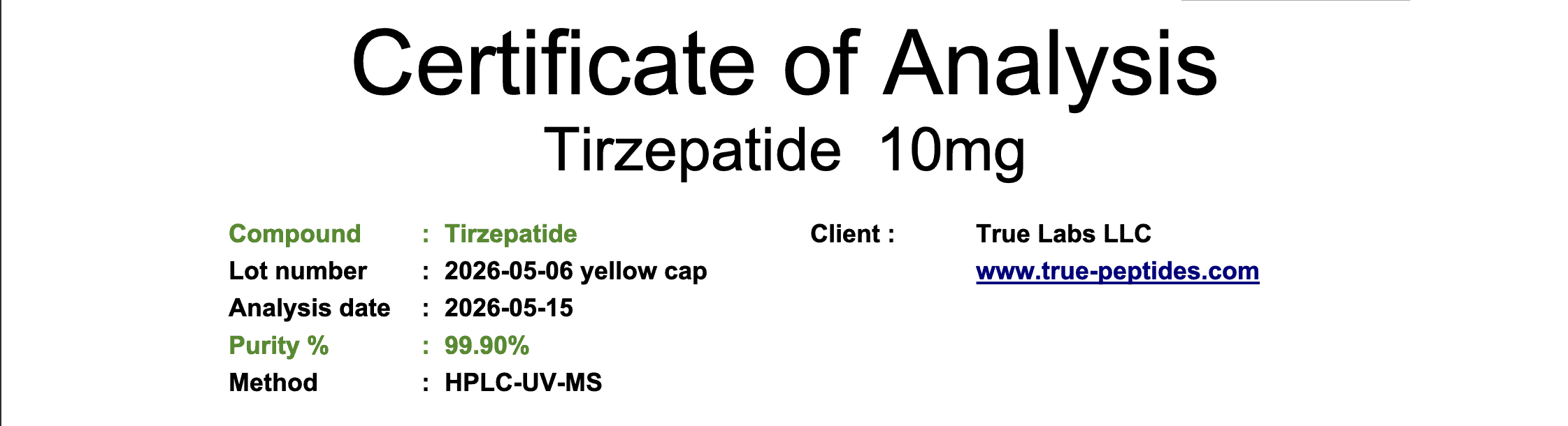
This information helps researchers identify and trace each batch across studies, which is crucial to the accuracy and reproducibility of an experiment.
Additional information some COAs may contain is:
- Molecular sequence or formula: refers to the elemental composition of the peptide molecule and specifies the amino acid arrangement and structural identity.
- Molecular weight: it identifies the total mass of the peptide to confirm the compound identity and modifications. It also helps researchers identify the appropriate solvent for maximum solubility.
- Chemical Abstracts Service (CAS) registry number: a numerical ID assigned to chemical compounds to prevent confusion, especially since many substances have multiple names.
For True Peptides, this additional information is linked to the PubChem (National Library of Medicine) website and is also available on our product information page.

2. Third-party Laboratory Information
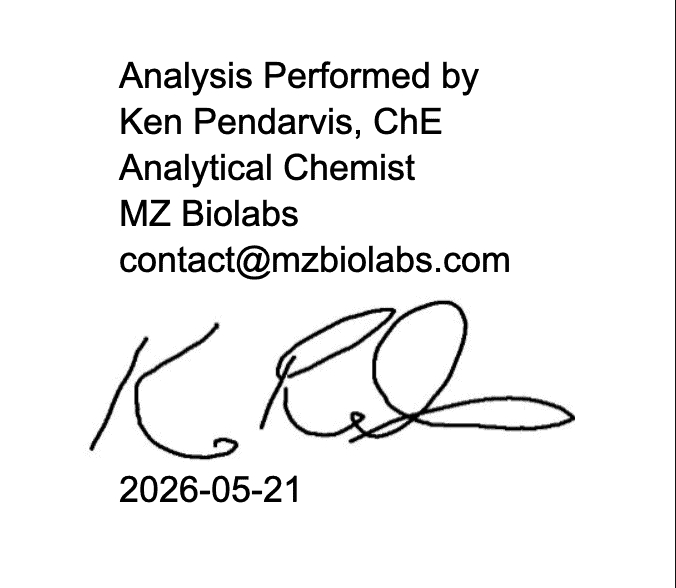
The peptide Certificate of Analysis also includes information about the third-party laboratory. It includes the third-party laboratory logo, name, address, contact information, and website.
It also contains a QR code as proof of authenticity that should link to the same exact COA with the same information.

It also includes the name of the licensed chemist who performed the test, and the date the COA was signed and released.
Some COAs may also include manufacturing information, including:
- Production date: when the peptide was synthesized
- Retest date or expiry date: when a re-assessment is necessary to ensure that the peptide’s quality still meets the standard requirement for experimental use
- Manufacturing method: specifies the synthesis approach used by the manufacturer, e.g., Solid-phase peptide synthesis (SPPS), or Recombinant production methods
- Manufacturing standards: if the peptides are manufactured according to specific standards, e.g., RUO or cGMP
The COA may also include storage recommendations to extend the peptide’s shelf-life, including temperature requirements, and reminders to avoid moisture and light to avoid degradation.
RELATED: How to Store Peptides for Long-Term Research Use
3. High Performance Liquid Chromatography (HPLC) Analysis
HPLC is the most commonly used method to assess a peptide’s purity as a percentage, which refers to the proportion of the desired peptide to the presence of impurities or byproducts.
The standard purity for research-grade peptides is 95%, but high-quality ones can test at 98% to 99%+ purity.
COAs include the HPLC chromatogram, which shows peaks corresponding to the target peptide and potential impurities.
The largest peak, as shown below, represents the primary peptide component, trizep, which tests at 99.90% purity. The other minor peaks, testing at 0.03% and 0.07% below, may indicate synthesis byproducts, degradation products, or residual impurities.
4. Mass Spectrometry Results
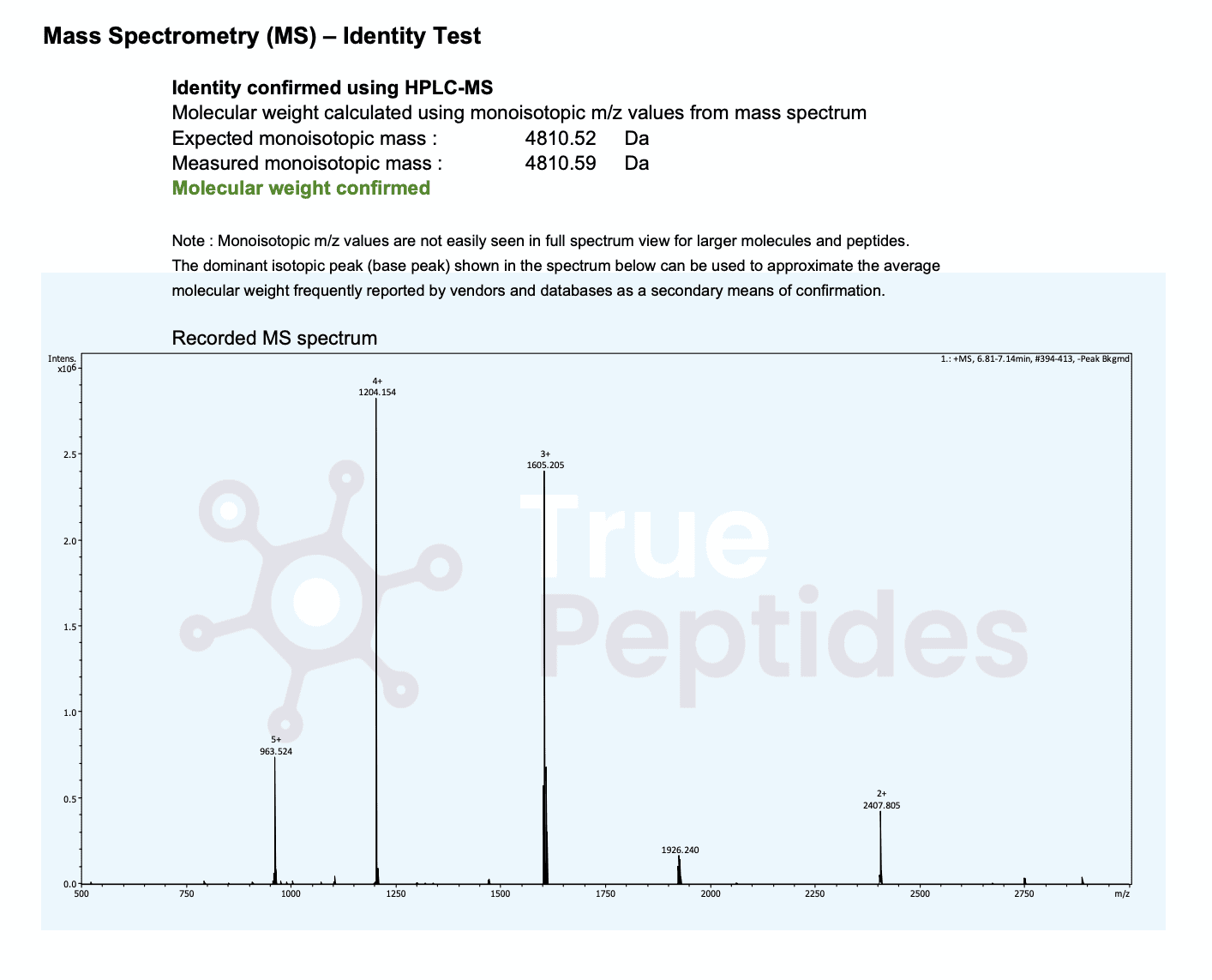
Mass spectrometry helps determine the amino acid sequences of peptides and quantify its proteins by measuring their mass-to-charge (m/z) ratios. It verifies whether the synthesized peptide matches the expected molecular structure by comparing them side-by-side.
A slightly larger measured mass than expected mass is normal; a slightly larger expected mass than measured mass may indicate in-source fragmentation, electron mass, or loss of small neutrals.
Additional Analytical Parameters Found on COAs
Appearance and Physical Description
Some COAs may also describe the color of the peptide found inside the vial. It may also indicate the physical form, whether it’s lyophilized or reconstituted, and other characteristics based on the appearance observed in the powdered or liquid peptide.
It’s important to note that appearance alone does not confirm the compound’s purity or identity.
Residual Solvent Testing
It is not uncommon for residual solvents to remain in the peptide after synthesis or purification processes. Analytical testing will help confirm the presence and levels of residual solvents in the peptide and compare them with the acceptable specifications for research purposes.
Important Things to Understand When Reading a Peptide COA
- High purity does not guarantee stability. A peptide with high purity may still degrade when handled improperly and stored under poor storage conditions.
- Purity and identity are distinct measurements obtained through different tests: HPLC for purity, mass spectrometry for identity. Both are important for the comprehensive characterization of the peptide for sale online.
- COAs reflect batch-specific results. Every batch will have its own COA that matches the batch and lot number on the packaging. Always compare lot numbers and analytical results in the COA to verify batch consistency.
- Always review the storage and handling information specific to the peptide found on the packaging or COA, as improper handling may affect peptide stability and affect study results.
RELATED: Research Peptides for Laboratory Use: Best Practices and Standards
Why Trust True Peptides’ Research Peptide for Sale
True Peptides is committed to meeting the high standards expected in peptide sciences and laboratory research. Our high-purity research peptides at 99%+ are supported by analytical verification from our manufacturers and third-party testers.
Every lot of our compounds is tested; not spot checked, not randomly sampled.
Customers can expect:
- Properly labeled vials with a unique lot number for easy tracking. This lot number is linked to the purity percentage, documented quantity, and a Certificate of Analysis, which clients can check on the product page before ordering.
- Full matching documentation. Each lot gets its own paperwork and testing. No recycled COAs.
- Full traceability. Every vial, COA, and test result is linked together. Customers can trace any product back to its lot, its test data, and its source documentation.
True Peptides maintains our transparency and integrity by providing high-quality research peptides that researchers can trust. We ship orders placed before 2 PM PST, and our support team is just an email away to assist with any queries.
See more of our high-purity research peptides here:
FAQs About Peptide Certificates of Analysis
What does peptide purity mean on a COA?
A peptide’s purity refers to the amount of the target peptide relative to the impurities in a sample. It is typically expressed as a percentage (e.g., ≥98%).
Higher purity indicates fewer detectable byproducts, but it does not guarantee long-term stability. It is usually determined by analytical methods like HPLC.
Why is HPLC used in peptide analysis?
High-performance liquid chromatography (HPLC) separates compounds based on their chemical properties, enabling the detection of impurities and the quantification of the main peptide.
It provides a clear purity profile and is widely accepted for peptide quality control. For peptides, it measures the percentage of the target peptide relative to the impurities.
What is the role of mass spectrometry in a COA?
Mass spectrometry (MS) confirms the peptide’s molecular weight, which helps verify its identity by matching the expected molecular weight and structure.
It complements HPLC by confirming the peptide’s composition rather than just purity.
Can a peptide have high purity but still degrade?
Yes. A peptide may test at high purity initially but still degrade over time due to heat, light, moisture, or improper storage.
A peptide’s stability depends on handling conditions, not just initial purity.
Why do COAs include lot numbers?
Lot numbers provide traceability to a specific production batch. This allows manufacturers and researchers to track quality control data, testing results, and production history, which can be useful for researchers looking to reproduce a study’s exact results by using the exact peptides from the same production run.
DISCLAIMER: Products sold by True Peptides are intended for laboratory and research use only. They are not drugs, food, or dietary supplements, and are not intended to diagnose, treat, cure, or prevent any disease. Not for human or animal consumption.
REFERENCES+
- Mant, C. T., Chen, Y., Yan, Z., Popa, T. V., Kovacs, J. M., Mills, J. B., Tripet, B. P., & Hodges, R. S. (2007). HPLC analysis and purification of peptides. Methods in molecular biology (Clifton, N.J.), 386, 3–55. https://doi.org/10.1007/978-1-59745-430-8_1
- Zhang, G., Annan, R. S., Carr, S. A., & Neubert, T. A. (2010). Overview of peptide and protein analysis by mass spectrometry. Current protocols in protein science, Chapter 16, Unit16.1. https://doi.org/10.1002/0471140864.ps1601s62